
The Hero's Journey Is Destroying the Planet
On conquest, dragons, and the mindset we need after the Hero comes home

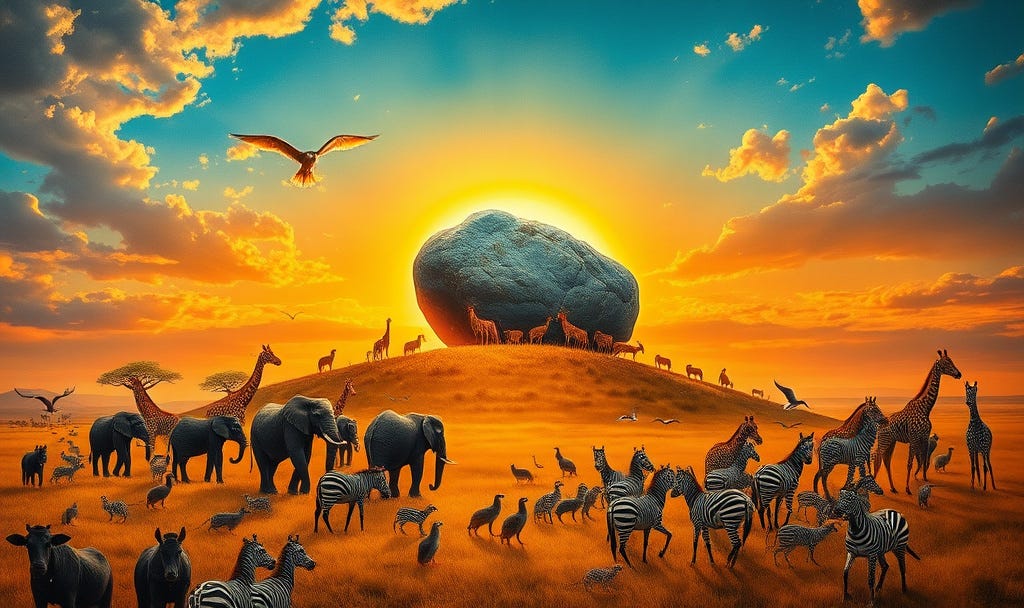
The sun rises over the Pride Lands. Animals converge from every direction — elephants, giraffes, zebras, meerkats, birds — moving toward Pride Rock in what The Lion King film frames as a coronation but what an ecologist would recognize as something else entirely: a fully functioning trophic web, every guild represented, every niche occupied, the whole system present and in balance.
The Circle of Life plays over the top of it, and the lyrics, for once, mean exactly what they say. Something is born, something dies, it becomes the grass, the antelope eat the grass, the lions eat the antelope, the lions die and become the grass again. A closed nutrient cycle. An ecosystem rendered as theology.
Then Mufasa takes his son to the edge of a cliff and tries to explain it to him.
“Everything the light touches is our kingdom,” he says. And then, crucially:
“We are all connected in the great Circle of Life.”
The lions are not above the circle. They are part of it. Their role is not ownership but participation — predation in service of the cycle, power accountable to the system that makes it possible.
And then the film does what Western storytelling has always done: it turns it into a Hero’s Journey not so much to teach children but to entertain. The Lion King came out in my birth year, 1994, which was a “5” Universal Year. The number 5 in numerology signifies taking a leap of faith while embracing the five senses, and that is what the Hero’s Journey is about. Let’s now explore The Hero’s Journey from the perspective of ecopsychology.
The Journey We Know by Heart

Joseph Campbell spent a lifetime documenting what he called the monomyth — the single story structure underlying mythology, religion, and narrative across cultures and centuries. The Hero receives a call to adventure. The Hero crosses a threshold into an unknown world. The Hero faces trials, finds helpers, endures an ordeal, claims a treasure, and returns home transformed.
It is Simba’s story exactly: the exile, the wilderness years, the return, the confrontation with Scar, the restoration of the kingdom. The rain falls. The Pride Lands recover. The rightful king is restored to his throne.
Campbell understood the Hero’s Journey as the story of ego development — the emergence of a strong, individuated self capable of facing the unknown and returning with something new. In this sense it is genuinely necessary. Children need this story. Cultures need this story. The capacity to leave the known world, face genuine difficulty, and return changed is a real and important human achievement.
But the Hero’s relationship to nature in almost every iteration of the monomyth is worth examining carefully. Nature is the realm of the unknown — the dark forest, the underworld, the wilderness, the dragon’s lair. It is the domain that must be traversed, survived, and ultimately left behind. The Hero passes through nature. The Hero does not belong to it. And at the center of the natural realm, in story after story across cultures, is the Dragon — the thing that must be slain for the Hero’s journey to be complete.
What the monomyth has never asked is what the dragon was doing before the Hero arrived.
The Dragon As the Tester of Faith
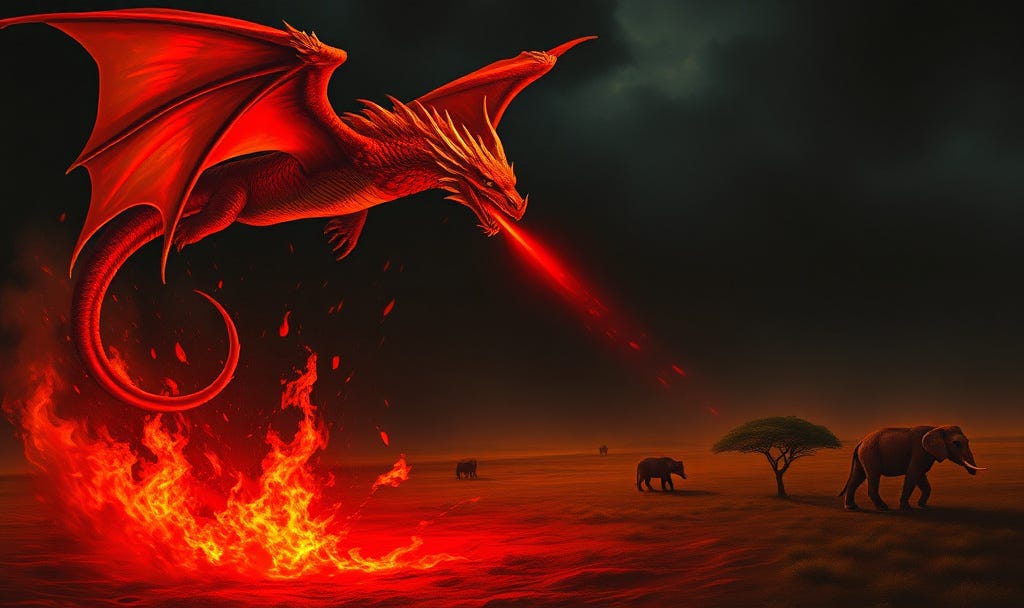
In European folklore, the dragon is the wolf made mythological — the apex predator scaled up to nightmare proportion, the wild, instinctual force that threatens the kingdom and must be eliminated for civilization to flourish. It hoards treasure. It guards the gates. It cannot be reasoned with or domesticated. It simply is what it is, unapologetically and completely, and that is precisely what makes it monstrous to the Hero’s civilization.
Jung read the dragon differently. In depth psychology, the dragon represents the unconscious itself — the deep, instinctual layer of the psyche that the developing ego must confront and integrate to become whole. Jung saw this same dynamic encoded in Christian symbolism: the Devil, he argued, functions as the collective Shadow of humanity — the repository of everything the Christian moral framework deemed unacceptable and cast into darkness.
Satan and the Jungian Shadow are not identical figures, but they arise from the same archetypal root: the rejected, the instinctual, the animalistic — the force that civilization casts out and then fears.
When the Hero slays the dragon and claims the treasure, something real is happening psychologically: the ego is asserting its capacity to engage with what it previously feared, integrating new energy, developing new capability. This is genuine growth. The dragon encounter is a necessary test of one’s faith.
What Jung also understood, and what the Hero’s Journey in its popular form does not, is that slaying the dragon is not the end of the story. It is the end of the first act. The dragon’s energy does not disappear when the dragon is killed. It goes somewhere — into the shadow of the civilization that killed it, into the elimination of everything that stands in the way of the kingdom’s expansion.
It appeared throughout history, most notably in the expansion of empires and even the United States through the ideology of “Manifest Destiny.” In this case, the Dragon represented the Native American tribes that had to be dismantled for the United States to expand westward and for industrial civilization to take root. Ironically, these Native American tribes tended to live in peace and harmony with the natural world.
In Yellowstone, the dragon was the wolf. Its elimination — completed across the continental United States by the 1930s, driven by the logic that civilization required its absence — produced the ecological consequences we explored in this series: the overgrazed riverbanks, the destabilized watersheds, the cascading loss of biodiversity that followed from removing the apex predator whose presence had structured everything else. The wolf was not hoarding the treasure. The wolf was the feedback mechanism that kept the treasure — the ecosystem’s health and resilience — intact.
The Hero slew the dragon and took the treasure. I argue that the real treasure is the Dragon’s secrets, not land or property. Material treasures can be hoarded and taken away. But the wisdom gained from the Dragon can live on forever.
The Chapter That Was Never Written
Here is where we actually are: the Hero has conquered the dragon. The treasure has been claimed. The kingdom has been built on it. The Hero has returned home.
And the dragon, it turns out, was the ecological system that made the kingdom possible.
Climate change is not a problem that arrived from outside the Hero’s Journey. It is the consequence of the journey’s success — the atmosphere destabilized by the carbon emissions that indirectly powered the civilization the Hero built. The loss of biodiversity is not a side effect of growth. It is what growth, pursued as the Hero pursues the dragon, inevitably produces.
The simplification of ecosystems, the elimination of apex predators, the building of new AI data centers, and the clearing of old growth — these are the treasure claims of a civilization that has been running a conquest narrative for five centuries and has only now reached the point where the consequences of the conquest outweigh the benefits to civilization. The more we build, the more carbon emissions we emit and the more damage we do to the environment.
The Hero has no framework for this moment. The monomyth does not include a chapter in which the returned Hero discovers that the dragon had a good side too. There is no established story for what comes next — which is precisely why the cultural response to climate change shifts so reliably between denial and paralysis.
Denial says the dragon wasn’t important. Paralysis says the story is over and we lost. Neither is adequate. Both are the responses of a culture that has only ever known one story and doesn’t know what to do when it runs out.
What is needed is not a better Hero. It is a different archetype entirely.
The Post-Hero Psychology
Jung’s full psychological map does not end with the Hero’s triumph. Individuation — the lifelong process of moving toward wholeness — goes further: past the Hero’s victory, into the confrontation with the Shadow, the integration of the unconscious, the emergence of the Self as something that includes and transcends the ego. The Hero’s Journey is the first act of a much longer psychological story.
The archetypes that this ecological crisis now demands are not weak ones. They require a different kind of courage than the Hero’s — not the courage to conquer but the courage to belong, to be accountable, to measure success by the health of what you are part of rather than the magnitude of what you have overcome.
The Restorer goes back to the devastated landscape not to claim it but to heal it. This figure asks not “what can I take?” but “what does this place need?” The Restorer’s heroism is invisible by the Hero’s metrics — it produces no trophy, no treasure, no monument to individual achievement. It produces a recovering watershed, a returning species, a restored forest. He or she does all this expecting no immediate return but with faith that it will pay off for future generations.
The Rooted Self understands identity as a node in a network rather than a sovereign individual. Contribution rather than conquest becomes the measure of value. Success is not what you have extracted from the system but what you have added to it.
The Elder — the mother tree, the wisdom figure who has survived enough cycles to understand the whole — knows that the health of the network matters more than the dominance of any individual node. This figure’s authority comes not from conquest but from depth of rootedness to its community.
These archetypes are present in Jungian psychology and in virtually every indigenous tradition on earth. They are notably absent from the dominant mythology of Western civilization. Their absence is not coincidental — the Hero’s Journey actively suppresses them, because they represent the values of the dragon’s realm: belonging over conquest, relationship over extraction, cyclical time over linear progress.
Simba’s Unwritten Chapter
Return to the Pride Lands, one year after Simba’s return.
The rains have come. The vegetation is recovering. The herds are returning. The Hero’s Journey is complete — the rightful king restored, the villain defeated, the circle resumed. It is, by every metric the monomyth offers, a success.
Now what?
Now Simba has to lead — not in the dramatic, dragon-slaying sense, but in the daily, essential sense. He has to make decisions about territorial boundaries and the management of the herds whose health determines the health of the grass that determines the health of the lions that eat them.
He has to understand the circle not as a beautiful idea but as a practical system with real feedback mechanisms and real consequences for getting it wrong. He has to become, in other words, not a Hero but a Steward — and the film, like the culture that produced it, has given him no preparation for this whatsoever.
Mufasa’s teaching was always pointing here. The Circle of Life was never a coronation speech. It was an ecological ethic — an account of what the lion at the apex of the system actually owes to the system that sustains it. The lions are part of the circle, not above it. Their power is accountable to the health of what they are part of.
The post-Hero psychology is not the rejection of the Hero. It is the Hero grown up — past the triumph, into the longer, quieter, more demanding work of what the triumph was actually for. This version of the Hero might best be called the Healthy Liger.
The Dragon’s Gift

In the oldest dragon myths, before the Hero’s Journey, dragons were not simply monsters. They were guardians — of borders, of buried treasure, of the boundary between the known world and something larger and older and more complex. To encounter the dragon was not always to slay it. Sometimes it was to be tested by it, transformed by the encounter with something that could not be conquered, made worthy of what it guarded by the willingness to face it honestly.
The climate crisis is the dragon at the threshold of the post-Hero world. It cannot be conquered with the tools that created it — not with more growth, more extraction, more heroic individual achievement in service of a narrative that treats the natural world as the territory the journey moves through rather than the community the journey belongs to.
It can only be passed through. And passing through requires a different story — one in which the returned Hero discovers that home is not a kingdom to be ruled but a living system to be belonged to, and that the health of that system is the only measure of the journey that ultimately matters. The health of the natural world also matters for public health, and that is the topic of this article.
The gift the dragon was always guarding was never gold.
It was the Circle of Life.
And here’s the reasoning behind it: the Destiny number of the phrase “Circle of Life” is 4. The same as “The Devil.” When we add Number 5, the Destiny number of “Lion,” with 4, we get 9. This number symbolizes the completion of a karmic cycle that happens when we come together despite our differences.
Let’s now come full circle and quote the theme song by the same name:
It’s the circle of life and it moves us all. Through despair and hope, through faith and love. ‘Til we find our place on the path unwinding. In the circle, the circle of life!
Which archetype do you find yourself living most — the Hero, the Restorer, the Elder? And which one does the moment we’re in seem to be asking for? I’d love to hear your thoughts in the comments.