
Pandemics and the Jungian Shadow
Why pandemics manifest at the edge of destroyed ecosystems.

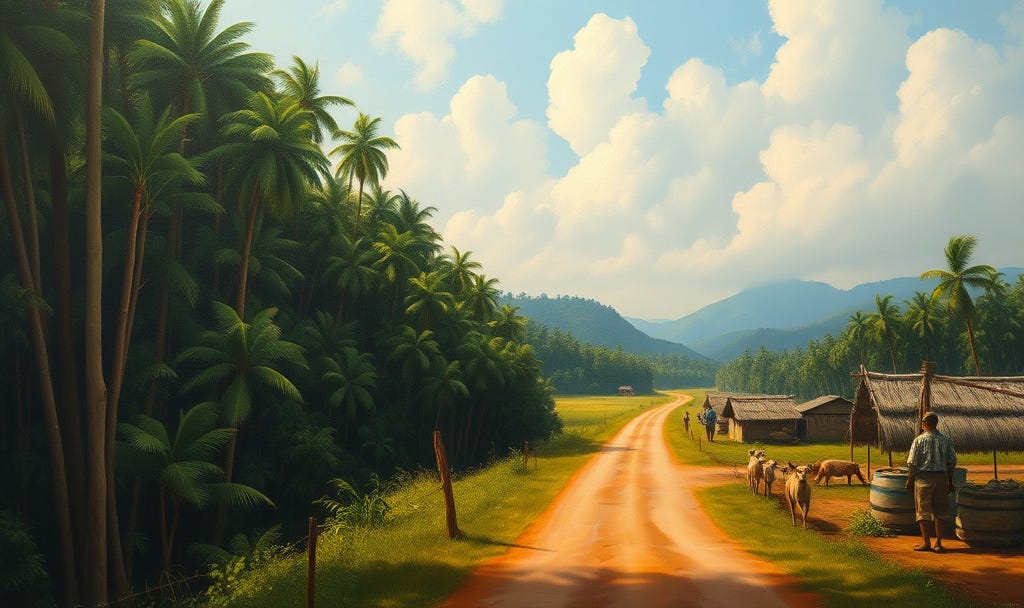
Picture a logging road cutting through the edge of a tropical forest. On one side, the dense tangle of primary jungle — layered, ancient, teeming with life most of us will never see. On the other side, a clearing. Maybe a small farm. Maybe a market where wild animals are sold alongside domestic ones, stressed and confined in ways they were never designed for.
This edge — this threshold between the human world and the wild one — is where most pandemics are born. That edge is called the ecotone. And just like nearly all people have psychological boundaries that, when crossed, make them angry; nature seems to create its own in physical form.
Not in laboratories. Not in cities. At the edge of the places we’ve destroyed.
If you lived through COVID-19 and found yourself wondering how we keep ending up here — how a virus jumps from a bat or a primate into the human population and then into a global crisis — the answer the scientists give is true but incomplete. The ecological explanation is real and well-documented. But underneath it there’s a psychological story, one that speaks to the underlying reason why these epidemics are happening.
What Zoonotic Spillover Actually Is
Most of the diseases that have frightened us most in recent decades — HIV, Ebola, SARS, Nipah, the Plague, and especially COVID-19 — belong to a category called zoonotic diseases. Zoonotic simply means the pathogen originated in an animal population before jumping to humans. It’s not rare. Approximately 60–75% of all emerging infectious diseases are zoonotic in origin. Three out of every four new diseases that appear in human populations start in animals.
For most of evolutionary history this wasn’t a crisis. Wild animals and their pathogens existed in their own ecological communities. Humans had limited, bounded contact with those communities. The biological barrier between the wild world’s microbial life and the human world’s was maintained by the simple fact of distance and diversity.
What changes that equation is what epidemiologists call a spillover event — the moment a pathogen makes the jump from its animal reservoir into a human host. And spillover events don’t happen randomly. They happen under specific conditions. Conditions that we are manufacturing at accelerating scale.
The Ecology of How Pandemics Begin

There’s a concept in disease ecology called the dilution effect that helps explain why intact ecosystems are actually protective against emerging diseases. In a biodiverse ecosystem — a healthy forest, a functioning wetland — pathogens are distributed across many different species. No single host species becomes the dominant reservoir. The diversity dilutes the concentration of any single pathogen.
When we fragment these ecosystems by doing logging activities for example, biodiversity collapses. What tends to survive habitat destruction are the generalist species — adaptable, resilient animals that can thrive in disturbed conditions. Rats. Certain bats. White-footed mice. And these generalist survivors are, almost without exception, the species best suited to hosting and transmitting pathogens to humans. The biodiversity buffer disappears and what’s left is a concentrated reservoir of infection in close proximity to human settlements.
Lyme disease in the northeastern United States is one of the clearest documented examples. As forest patches shrank through development, white-footed mouse populations came to dominate. Tick feeding became concentrated on these highly competent disease hosts. Lyme disease prevalence rose predictably in direct proportion to rates of deforestation. The disease didn’t come from nowhere. It came from the specific ecological wound of fragmentation.
The same basic story repeats with every major zoonotic emergence of the past fifty years, just with different species and different pathogens.
Nipah virus emerged in Malaysia in the late 1990s when fruit bat populations — displaced from disappearing forest by drought and agricultural expansion — moved into fruit trees on pig farms. Bats infected pigs. Pigs infected farmers. A novel virus with a case fatality rate of up to 75% appeared seemingly from nowhere. It didn’t come from nowhere. It came from the edge of a deforested landscape where bats and humans were forced into novel proximity.
Ebola outbreaks in Central Africa consistently trace back to the forest frontier — the places where logging, mining, and agricultural expansion bring humans into contact with primate and bat populations carrying filovirus pathogens that have existed in those communities for millions of years without ever having a pathway into humans.
HIV’s origins have been traced to the hunting of chimpanzees in degraded Central African forest in the early twentieth century — the bushmeat trade bringing humans into direct blood contact with a primate population carrying a precursor virus that crossed, adapted, and became the defining pandemic of the late twentieth century.
The wildlife trade adds another layer of risk. Wet markets and wildlife trafficking networks are, from an epidemiological perspective, incredibly efficient systems for concentrating animals from diverse wild populations — each carrying their own microbial communities — into confined spaces with high human contact. Stressed animals shed pathogens at higher rates. Multiple species in proximity create opportunities for novel recombination and mutation events. The conditions are almost designed to generate spillover.
The Shadow at the Edge

Here’s where I want to bring in a psychological framework to think about this topic in a deeper way — not to replace the epidemiology but to sit alongside it, because I think it illuminates something the science alone doesn’t quite reach.
Carl Jung described the Shadow as the repository of everything a person — or a culture — cannot accept about itself. Not necessarily evil, just unwanted. The qualities, impulses, and dimensions of experience that get pushed out of conscious awareness because they don’t fit the story we’re telling about who we are.
For Western civilization, the natural world has functioned as the primary Shadow screen for a very long time. The wild is everything we’ve decided we’re not — ungovernable, mortal, instinctual, dark, beyond our control. We’ve built our self-image as a civilization around the conquest and management of nature. The forest, the swamp, the predator, the darkness — these are what we push to the margins. Literally and psychologically.
And here is what Jung observed about the Shadow, consistently and without exception: what gets pushed to the margins doesn’t disappear. It accumulates like shoveled snow in the cold recesses of the subconscious mind. And eventually it returns like an avalanche which causes fear to those affected. The virus at the edge of the destroyed ecosystem is the Shadow’s return in its most literal form.
In other words, the psychological dynamic and the epidemiological dynamic are the same dynamic operating at different scales. If human civilization cannot recognize the natural world as part of itself, then we cannot consistently act to prevent the conditions that make pandemics inevitable. Pandemics will continue to occur again and again and we will call it fate. But it’s not fate. It is what happens when we ignore environmental stewardship. Deforestation not only causes epidemics but also contributes to greenhouse gas emissions that cause climate change. In this way, it does spill over into other areas of public health.
We know what creates spillover risk. We have known for decades. The scientific literature on habitat fragmentation, wildlife trade, and zoonotic emergence is not new or contested. What keeps failing is not the knowledge. It’s something underneath the knowledge — the same force that drives the ecological destruction in the first place.
What Standard Public Health Gets Right and What It Misses
As an MPH, I will make clear that the standard pandemic preparedness framework is genuinely valuable. Surveillance systems that detect novel pathogens early. International coordination is arranged by the World Health Organization (WHO). Vaccine platform technology that can be deployed rapidly against emerging threats. These things matter and they save lives.
But they all share one structural limitation: they are responses to emergence after the ecological conditions that facilitate the spread of disease have already been created. They are downstream interventions in a system whose upstream drivers they are not designed to address.
The most ecologically sophisticated current framework in public health is called One Health — the recognition that human health, animal health, and environmental health are inseparable and must be addressed together. This is a significant conceptual advance and it points in the right direction. But even One Health largely stops short of asking why the ecological destruction that creates spillover conditions keeps happening despite the logical evidence of its consequences.
The answer to that question is not primarily scientific. The science is clear. The answer is psychological and cultural — it lives in the Shadow that drives the relationship between civilization and the natural world. A pandemic prevention framework that doesn’t address the Shadow (deforestation in this case) is like trying to “deal with” the problem we created versus trying to prevent the problem from happening at all. The first approach involves only logic, the second involves being wise. In truth, logic (The Lion) and wisdom (The Tiger) should go together in a functional society. Hence why we call this publication “HealthyLiger.”
What Any of Us Can Do With This
I want to be careful here not to reduce a systemic problem to individual responsibility. The ecological destruction that creates pandemic risk is driven by global economic systems, policy failures, and structural forces that no individual can address alone.
But the Shadow dynamic that operates at the civilizational scale also operates at the personal one. And the personal work is not separate from the systemic change — it’s part of what makes systemic change possible.
Three things that are genuinely available to anyone reading this:
Think deeply about it. The numbing that makes ecological destruction tolerable is the same numbing that makes pandemic risk feel abstract and inevitable. The person who can genuinely grieve the loss of a specific forest, a coral reef, a specific animal community is more connected to the ecological reality that the epidemiology describes than the person who processes it as information. Grief is not the opposite of action. It’s often what makes action real rather than performative. Just to be clear, when I say “grief,” the act of crying isn’t needed here, just an acknowledgement of what could be if we actually worked together diplomatically to achieve the goal of mitigating deforestation.
Notice your relationship with the animal body. The civilization that projects its Shadow onto the wild natural world is the same civilization that has difficulty accepting its own animal nature — mortal, embodied, instinctual, dependent on ecological conditions it didn’t create and can’t fully control. The personal practice of taking responsibility for rather than suppressing your own animal nature is the inner version of the outer work of ecological reconciliation. They go together.
Pay attention to boundaries. The ecological edge where spillover happens — the ecotone between the human world and the wild world — exists in personal experience too. The places in your own life where the comfortable and the wild meet, where the known ends and the genuinely uncontrollable begins. Learning to approach those boundaries with curiosity rather than the compulsion to control is the psychological practice that corresponds to maintaining rather than destroying the ecological thresholds where the wild and the human can coexist.
The Native Americans of the Americas knew this clearly, but the Western settlers literally destroyed their forested communities while spreading their infectious diseases onto them due to the same phenomenon I outlined here. We can change that for our global population by pursuing reconciliation (“reforestation efforts”) with Mother Nature again, and embracing politicians that seek this through political and legal means.
The logging road at the edge of the forest is not just an epidemiological risk site. It is a mirror of us. It shows us exactly what happens when a civilization reaches the margins of what it has pushed away — and finds the pushed-away thing waiting there, patient, ancient, and no longer containable.
The question the virus asks is the same question the Shadow always asks: are you ready to recognize what you expelled?
The answer we give — collectively and individually — is the most important public health intervention available at this time.
This piece sits at the intersection of public health, depth psychology, and ecology — the territory I write about every week on this Substack. If it resonated, consider subscribing for more.