
Why Seven Is the Number of Creation Itself
"In the beginning, God created the heavens and the Earth" (Genesis 1:1 NIV)

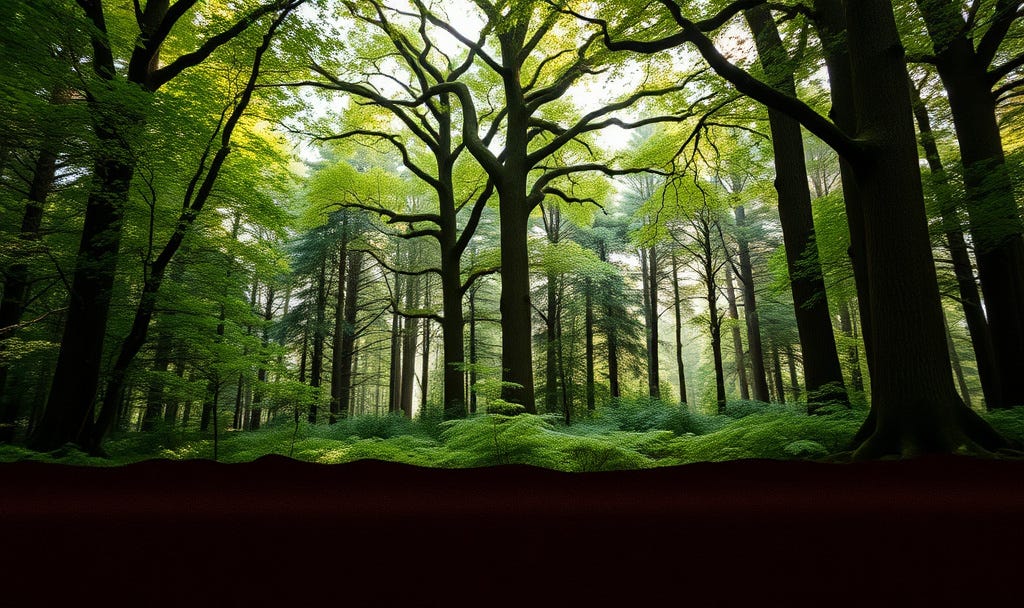
Above you there is canopy — the interlocking crowns of the dominant trees, filtering light into a green diffuse glow. Above that, there are trees, the giants that have broken through the roof and stand alone in full sun. Below the canopy, younger trees hold their position in the understory, patient and shade-tolerant. Below them, the shrub layer. Below that, the herbs and ferns. Below that, the mosses and ground cover, the leaf litter, the slow decomposing mat of everything that has fallen. And below that — below the visible world entirely — the soil layer: fungi, bacteria, the ten thousand organisms that make the whole thing possible.
Count the layers. You keep arriving at the same number.
Seven.
This is not a mystical claim. It is an ecological one. The forest has seven recognized strata — this is consistent across ecosystems. So that begs the question:
What if the number seven is not random? What if it is, in the literal sense, natural or even divinely designed?
The Seven Layers
The vertical stratification of a forest into seven layers reveals that what looks like chaotic abundance is actually a precisely organized system.
Starting from underground (1-6=Below) up to the sky (7=Above):
the soil and root layer, where fungi and decomposers break down the dead and make the living possible — the forest’s unconscious, working in darkness.
The ground layer, mosses and lichens and leaf litter, the slow accumulation of what has fallen.
The herb layer, low-growing plants, ferns, wildflowers adapted to deep shade and dappled light.
The shrub layer, woody understory plants carving out their own ecological niche between ground and canopy.
The understory layer, young trees and shade-tolerant species that form the forest’s middle
The canopy layer, the dominant trees whose crowns form the forest’s primary roof.
And finally the emergent layer, the tallest trees breaking above the canopy into open sky, where light is unlimited
Each layer is not merely a zone but a complete ecological community — distinct species, distinct light regimes, distinct moisture and temperature profiles, distinct webs of relationship. The layers interact, exchange, support one another. They are simultaneously independent and deeply interdependent. Remove any one layer and the system reorganizes, compensates, and rebuilds.
The forest did not choose this number. It arrived at seven through hundreds of millions of years of evolutionary pressure toward maximum complexity and resource efficiency. Seven layers is what that optimization produces, reliably, across the temperate and tropical forests of a planet.
And Homo sapiens evolved inside it. We have been looking at seven layers every time we fall into chaos and rise again.
Seven in Ecological Time
The number is not only structural. It also appears in ecological time.
Ecological succession — the process by which a disturbed ecosystem progressively rebuilds itself — moves in rough phases that field ecologists have long observed follow an approximate seven-year rhythm in many systems. The first years after a disturbance bring pioneer species: the fast-growing, light-hungry opportunists. Around year three to four, woody shrubs begin to establish.
By year seven, young trees are competing for dominance and the character of the site has fundamentally shifted. This is not a precise clock — ecology is not a metronome — but the seven-year mark is a real inflection point in succession ecology, the moment when one phase gives way to the next.
The point is not that nature runs on exactly seven years. The point is that a species as observant as ours, living for tens of thousands of years inside these systems, would inevitably have internalized this rhythm. Seven is the tempo of the living world.
The Human Seven
Seven is the most ubiquitous number in human culture, appearing across civilizations with a frequency that has baffled anthropologists. Seven notes in the Western musical scale, and the octave as the point of return — the eighth note is the first note again, suggesting that seven is the number of distinct steps before the pattern completes. Isaac Newton, famously, divided the visible spectrum into seven colors to mirror the musical scale — the choice was partly arbitrary, but the tendency to group the rainbow into roughly seven bands is real and cross-cultural.
Seven appears in the world’s major religions consistently. Seven heavens in Islamic cosmology. Seven days of creation in Genesis. Seven chakras in Hindu and yogic tradition. The Buddhist teachings speak of seven factors of enlightenment. Ancient Egypt organized its sacred calendar around seven-day weeks long before Babylonian influence is documented in the region.
Scripture reaches the same number by a different path. In Genesis, the natural world is called into being across seven days — the first and most foundational act of creation organized as a seven-part cycle. In Leviticus, God instructs that the land itself must rest every seventh year: no sowing, no pruning, no harvest. What ecology now calls succession rhythms and recovery cycles, ancient sacred law encoded as divine commandment. The writers of these texts were, before anything else, people who lived close to the land. It is worth asking whether they were simply recognizing a pattern the natural world had already written rather than inventing the story out of thin air.
Pattern Recognition: Humans, AI, and Nature
Here is the bridge between nature and symbol:
Human beings are, before almost anything else, pattern-recognition animals. This is not a metaphor — it is a precise description of how our brains are unique compared to that of other animal species. The brain is fundamentally a prediction machine, constantly scanning the environment for recurring structures, encoding them, and using them to model what comes next. We do not experience the world as raw data. We experience it as pattern, as rhythm, as structure that we have learned to expect.
This pattern-recognition function is also shared with AI, however we also have intuition which is something silicon chips don’t have. The key for making a New Earth is using the human brain with AI productively, not outsourcing our minds to AI. In other words, AI should assist us in pattern recognition but not replace the human brain. This collective act called transhumanism would be analogous to the Fall of Lucifer but for humanity itself. In that timeline where pattern recognition is only automated, our shadow and fears would then consume us, literally. Not because it was forced on us but because we refused to do the shadow work needed.
The patterns we absorbed most deeply are the ones we lived inside the longest before AI existed. The seven-layered world. The seven rhythms of ecological succession. These patterns were not observations we made once and recorded. They were the architecture of the world we inhabited for the full span of our evolutionary history — written into us not just as memories but as expectations, as felt senses, as something very close to instinct.
When those patterns recur in symbolic systems — in music, in cosmology, in sacred numerology — we are not inventing meaning from nothing. We are recognizing, in a new medium, a structure that was already encoded in us. The structure feels significant because it is significant — not because we created it but because we recognized what was created from the beginning.
From this perspective, the number seven is not mystical in origin. It is natural. Its mystical resonance is the echo of its ecological one.
What Numerology Gets Right
Numerology, as a formal practice, has a credibility problem in society. The idea that the number of letters in your name determines the destiny of your life is not supported by evidence and conflates pattern with causation in ways that don’t hold up. This is the idea that the ancient form of Chaldean numerology promotes, that our numbers point to our destiny. And that is incorrect, ego-driven in fact.
Pythagorean numerology, that which takes the approach of correlation not causation, is much more believable. In this system, the so-called “Destiny Number” and “Expression Number” are the same thing. They point to underlying patterns in terms of what lessons we’re meant to learn and what we’re meant to create in this life, much like astrology does. In Jungian psychology, this can be understood as psychological tendencies in the form of archetypes we are meant to eventually experience.
The more interesting question has never been “is numerology true?” It is “why does it feel true?” — and the ecological answer is more grounded and ultimately more interesting than either affirmation or dismissal.
Numerology’s value is not predictive but revealing: it offers a way to organize experience using patterns that feel native because, in the deepest sense, they are. This is not reflecting causation at all, it is simply pattern recognition with humility attached to it, and pattern recognition can lead to a sense of order being perceived by the mind even though it looks like chaos from the outside. As within seems like divine order from this perspective, so without looks like chaos. The Hermetic principle appears again here as “As within, so without.”
The Pattern That Comes Back
The seven layers of the forest are still there, whether or not anyone is counting them.
The soil layer works in darkness, breaking down the dead into the nutrient stream of the living. The emergent trees stand alone above the canopy in full light. The succession cycles turn, imprecise and real, marking time in the way the living world marks time — not with clocks but with change.
I argue that seven was never an invention, it was a discovery. If so, how would anyone explain the Expression numbers of these four terms all being seven?
As above:
“Holy Spirit” is 7
“Jesus Christ” is 7
So below:
“Earth” is 7
“Yahweh” is 7
Using numerology, one can assume that “Yahweh” is the Biblical name for the Shadow of Earth or “The Demiurge.” This makes sense if the proposition that God created the heavens (7) and the earth from the Book of Genesis is a true statement. The fact that Number 8 is the infinity symbol made vertical points to the “As above, so below” concept which only applies to the physical domain where time exists. Another synchronicity is that the destiny number of “heaven” is 1 and “Earth” is 7, when we add 1 and 7 we get the Destiny Number of “God” which is 8.
So let’s go back to the main idea of this piece: it is abundantly clear that the number 7 is embedded in the design of creation as the Book of Genesis states. Number 8 represents infinite abundance while 7 represents the seven contrasting dimensions between darkness and light.
In this model of reality backed by numerology, the “New Earth” is associated with reaching 4th density which is the middle number. Finally, the fearsome Yahweh becomes known simply as “Mother Earth” at 5th density when her shadow work is completed. Until we get there, Yahweh will continue to use natural disasters as catalysts to help us wake up and address the climate crisis more directly.
Thanks for reading my 7th article. Do you have a number that has always felt significant to you — one that keeps appearing in your life in ways you can’t fully explain? I’d love to hear about it in the comments.