
What Forests Taught Me About the Collective Unconscious
On forests, Jungian psychology, and the hidden architecture of creation

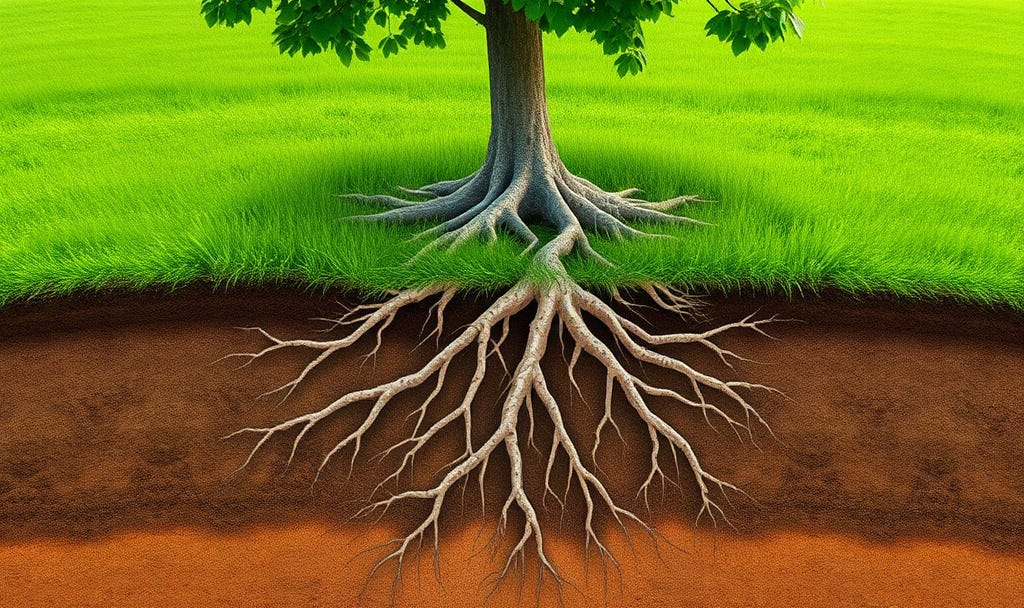
Stand in an old-growth forest and you will see lifeforms, just like us.
Tall trees, short trees, trees leaning toward the light, trees in the shadow of larger ones. Distinct organisms, separate lives, each rooted in its own patch of ground. This is what centuries of Western thinking about nature — and about the self — have trained us to see: discrete units, each pursuing its own survival strategy.
Beneath your feet, something else entirely is happening.
In the last few decades, forest ecologists have uncovered something remarkable: trees are not competing individuals. They are nodes in a vast underground network of fungal threads — mycorrhizal fungi — that weaves through the soil connecting root to root across an entire forest. Through this network, trees share carbon and water, transmit chemical signals of stress and threat, and preferentially support their weakest and youngest members. The forest you see above ground is, in a precise and literal sense, not the forest that actually exists. It is literally an ecological representation of the esoteric concept: “As above, so below.”
Carl Jung, working from a desk in Zurich in the first half of the twentieth century and arriving by a completely different route, described something structurally identical — not in forests, but in the human psyche.
He called it the collective unconscious.
The Forest We Thought We Knew

Suzanne Simard, a forest ecologist at the University of British Columbia, began dismantling our assumptions about forests in the 1990s. She discovered that Douglas fir trees were transferring carbon to nearby birch trees through underground fungal networks — not accidentally, but in patterns that suggested something more intentional. When she mapped the networks in more detail, she found that the oldest and largest trees — what she would come to call “mother trees” — were the most connected, serving as hubs through which resources and information flowed to dozens of other trees, including their own seedlings. When mother trees were dying, they transferred disproportionate amounts of carbon and defense signals to the trees around them.
The forest was behaving like a community with memory and care, not a collection of rivals.
The mycorrhizal network shares nutrients, moving carbon from resource-rich trees to resource-poor ones. It transmits stress signals — when a tree comes under attack from insects or disease, neighboring trees ramp up their own chemical defenses before the threat arrives. It supports seedlings that would otherwise fail, unable to photosynthesize enough in the deep shade beneath a canopy. As Merlin Sheldrake writes in Entangled Life, the fungi in this network are not passive conduits — they are a living medium through which the forest thinks.
Jung’s Underground
Jung began where Freud left him: with the personal unconscious. The layer of the psyche beneath conscious awareness, containing repressed memories and unacknowledged desires. This was radical enough. But Jung kept going deeper.
What he found was another layer beneath the personal unconscious — one that was not personal at all. A layer of psychic material shared across individuals, cultures, and millennia. He called it the collective unconscious, and he understood it not as a repository of shared memories but as a shared architecture: a set of deep patterns that shape human experience from below. He called these patterns archetypes — not images themselves, but the tendency to generate certain images, to be moved by certain stories, across all times and places with a consistency that coincidences alone cannot explain.
Jung’s own language was, in large part, ecological in nature. He spoke of the individual psyche as a plant whose roots reach into a common soil. He understood the personal and the collective as continuous — the individual psyche growing from and remaining embedded in something larger, something impersonal, something ancient.
He did not know about mycorrhizal networks. But he was describing one. That mycorrhizal network is what New Age spirituality calls “The Matrix.” It is believed to be where all the thoughts of humanity intersect and create physical reality much like how the integrity of the root system of a tree make it possible for the tree to exist.
So by this logic, if we change our thought system (aka “our consciousness”), our entire reality changes and a stronger tree is born in its place. This is a good analogy to what New Earth means. By doing “shadow work,” we burn down the old tree representing the shadow and grow a new one in its place. A similar metaphor is given by Jesus in Bible verse Matthew 13:31, here a mustard seed births a new root network which then eventually sprouts to become a tree and birds perch on the branches.
The Structural Parallels
Lay the two systems side by side and the links are not vague or poetic. They are precise.
Invisible infrastructure, visible effects. The mycorrhizal network is entirely underground — you cannot see it working. What you can see are its effects: the health of trees that should be failing, seedlings surviving conditions that should have killed them. The collective unconscious operates identically. No one has ever observed it directly. We perceive it through dreams, through the spontaneous eruption of mythological themes across cultures, through the way certain images move us with an intensity our personal histories cannot account for.
Sharing across apparent separation. The network moves carbon from surplus trees to depleted ones, across species and distances, without the giving tree having any knowledge of what it is doing. The collective unconscious moves meaning in an analogous way — a symbol alive in one culture appears, without documented transmission, in another; an image from a contemporary patient’s dream turns up structurally identical in a Vedic text from three thousand years prior. Something is moving through the network. We just can’t see the threads.
Stress signals and collective transmission. When a tree comes under threat, its distress is broadcast through the network and the community responds collectively. We see something like this in human collectives: grief and trauma propagate through generations in ways that exceed conscious transmission. Populations carry the psychic residue of events their members never personally experienced. The body holds what the mind cannot process, and the collective holds what the individual cannot carry alone.
Mother trees and the elders of the psyche. The oldest, most connected trees are hubs of influence — their loss diminishes the whole network’s stability. In Jungian psychology, certain archetypes function as organizing centers around which psychic life (“the psyche”) tends to structure itself. Their activation in dreams, in therapy, in ritual reorganizes the whole in ways that smaller figures cannot.
The network includes the dead. Mycorrhizal fungi persist in dead wood long after the trees they served have fallen, carrying forward the biological legacy of organisms that no longer exist as individuals. The collective unconscious does something structurally similar — it carries the psychological inheritance of people and cultures long gone. People who are long dead continue to affect the collective, Jesus Christ and Buddha are the most famous examples.
At the same time, the astral realm is believed to be inhabited by spirits, those who have not crossed over, that influence our thoughts in ways that are negative. Christians call these “demons,” New Age calls these “dark entities.” I would take a more grounded approach and focus on one’s inner psychological response to these triggers versus externalizing blame. When we combine Christian language with Jungian terms, Satan symbolizes the Shadow and demons (if they exist) serve the Shadow. By thinking of it in this way, the symbolic root system is strengthened over time and not weakened by external forces that we are not aware of. This is a practical implementation of the Hermetic principle: “As within, so without.”
What This Means for How We Understand Ourselves
Both frameworks challenge the same foundational assumption of modern Western culture: that the individual is the fundamental unit of life.
What ecology and Jungian psychology both suggest is that the boundary is real but not primary. You are an individual — and you are an individual part of a larger network. The tree exists as a discrete organism and simultaneously as a node in a network without which it would not have survived its first year. The psyche is genuinely personal and simultaneously rooted in a shared substrate that no individual created and no individual contains.
The word for this, in ecology, is permeability. Trees are permeable to the network — to chemical signals passing through the soil from distant members of the community. We are permeable too: shaped by archetypal forces we didn’t choose, moved by symbols whose significance predates us by millennia, carrying collective wounds we didn’t personally sustain and collective wisdom we didn’t personally acquire. This is not mysticism. It is a description of structure.
Roots to the Law of One
Go back to the forest now.
You are standing among trees that your eye sees as separate. You know now what is underneath. The knowledge changes the quality of the seeing — not what you observe but what you feel yourself to be standing inside. The separateness is real. And the connection is more real, older, more fundamental than the separateness.
Jung once wrote that the psyche is not a thing we have but a world we inhabit. The mycorrhizal researchers have said something almost identical: the forest is not a collection of trees but a single, distributed organism, temporarily expressed as individuals who believe themselves to be alone.
Both arrived at the same quiet conclusion from opposite directions. That the surface is separation. That the structure is connection. That what we are, beneath the boundary of skin and bark, is not nearly as singular as we have been led to believe.
The next time you feel something that seems too large to be personal — a grief that exceeds your circumstances, a longing you cannot trace to any individual source — consider the possibility that you are not generating it alone.
You may be receiving a transmission. And the way you react to these thought forms or “pendulums” determines your future timeline. Will you react with love or fear? Will you follow the example of the plant kingdom and realize our interconnectedness or see us as separate trees, some tall and others short? Will you adopt the mindset called “as above, so below,” or do you instead read this article with skepticism and say: “I’m above, your below.” Think about it and comment down below.
The network has been sending messages long before you arrived. And it will keep sending long after your particular expression of it is gone. In summary, the evidence points to the fact that we are all one consciousness spread across different identities (“souls”) and this provides a solid logical and rational basis for the New Age idea called “The Law of One.”
What does this bring up for you — the idea of being a node rather than an endpoint? I’d love to hear your reflections in the comments.