
The Wheel Turns: On Solstices, Seasons, and the Intelligence of Cyclical Time
What the seasonal cycle knows about the psyche — and what we lose when we stop noticing the contrast.

The summer solstice arrived recently but no one really noticed.
No dramatic shift in the sky, no perceptible change in the heat. Just a specific point in the earth’s orbit — the moment the Northern Hemisphere tilts closest to the sun — after which the light begins, by seconds at first, to recede. It has already happened before most of us notice, especially in areas of the world by the equator. The turning point is not an event you can watch, it is one we feel.
And here is an interesting fact: the longest day is also the first day of the returning darkness. At the exact peak of summer’s light — the moment we have been moving toward since December — the wheel quietly turns back. The days are already shortening. Not perceptibly, not yet. But the arc has reversed, and the living world knows it before we do.
For most of human history, this point in time was one of the most significant moments in the calendar year. Cultures across the world marked it with fire, with feast, with ritual, with the specific kind of attention that human beings pay to things they understand to be important. They were not being superstitious. They were being observant — tracking a real pattern in the living world and recognizing that it had influence on them.
We have largely stopped listening.
We live now in climate-controlled interiors, under artificial light that extends the productive day indefinitely, eating strawberries in January and working to the same schedule in June as in December. The seasons have become background rather than rhythm — something that happens outside, to the weather, while we remain insulated from its intelligence inside.
The body has not forgotten the wheel of nature, even when the mind has stopped turning with it. So let’s discuss the four seasons, how they impact us psychologically, and how we can see nature as a mirror of our inner selves.
Summer: The Expansion Phase

Summer is the season of maximum expression — maximum solar energy, maximum biological productivity, maximum complexity in the living system. Everything at full expression simultaneously, the ecosystem running at the height of its capacity, nothing held in reserve. The Sun’s heat symbolizes the masculine principle of creation, that which gives more energy than it receives.
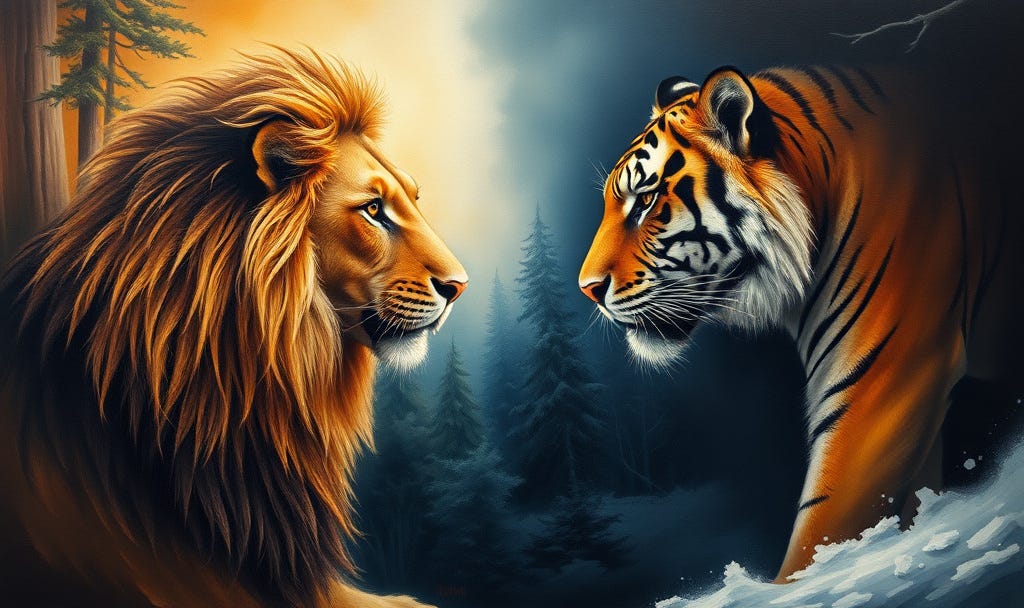
When the ego is grounded in logic as well as wisdom from past experiences, it becomes “divine” and this is symbolized by the Lion. The archetypal opposite of the Lion, the "persona” in Jungian terms, manifests as the Lamb. One who takes pride from being a victim, and often forms “prides” with other like-minded people, pretending that they are lions.
Jung might have recognized this as one of nature’s more precise psychological teachings. Summer is the season of the ego at its height — outward-facing, confident, productive, fully expressed in the world. And the solstice is the moment the Self begins its quiet call back inward. The light that has been expanding all year reaches its limit and begins its return to the dark.
What summer asks of the psyche is one of the most difficult things the psyche is ever asked: to be fully present in fullness without clinging to it. To be joyful while remaining humble to the knowledge that it will not last.
Autumn: The “Letting Go” Phase

In ecological terms, autumn is the season of change and contrast, both literally and metaphorically. In symbolic terms, we can say it is the time of the Liger. A Liger is the hybrid offspring of a male lion and a female tiger. When applied as an archetype, it closely resembles the theme of autumn.
Instead of disowning the shadow, we attempt to let go of what no longer serves us and work towards integration. Ligers are bred by humans, so it’s a perfect teacher of what we all should be. We should acknowledge our inner animal (“shadow”) while also using our minds more effectively so that we can become “fully human.”
As the light recedes and temperatures drop, trees make complex decisions about resource allocation — reclaiming nutrients from leaves before dropping them, investing in root systems for winter, releasing what can no longer be maintained. The chemistry of this process is what produces autumn color: the breakdown of green chlorophyll revealing the underlying pigments — the reds, oranges, and golds — that were present all along, hidden beneath the productivity of summer.
Autumn asks the psyche to release — completed cycles, finished chapters, the version of yourself that served a previous season but cannot survive the coming winter. An identity outgrown. A way of being in the world that was necessary once and is necessary no longer. And like the tree in the process of letting go, the psyche often reveals its most essential qualities precisely in what it releases and how.
The grief of autumn is real and it should not be bypassed. Grief, ecologically understood, is not the opposite of growth — it is the mechanism by which what is finished gets composted into what comes next. The fallen leaf becomes the soil that feeds the root. The released identity becomes the ground from which the next one grows.
This connection I mention is not a faith-driven opinion, it is based on logical evidence from numerology. In numerology, one can compute the Destiny Numbers of the words “grief” and “autumn.” They are both in the “9” energy that matches the word “ego.” It creates the triad that numerologists call Angel Number 999.
Grief does not necessarily mean the act of crying as popular culture tends to think of it, it is just the emotional response to acceptance of the consequences of one’s past actions or ignorance on reality. The way we productively utilize this period is to embrace our minds and learn from our mistakes rather than feel guilt from them.
Winter: The Hermit Phase

Now we transition from Autumn to Winter. The first thing ecology teaches about winter is a distinction that changes everything: winter is not death. It is strategic withdrawal. Think of it like a “hermit phase” or a phase of necessary contraction. Many people subconsciously think contraction and cold equals fear but when we think more deeply, it can be a productive period. It certainly is for the plant kingdom.
Beneath the snow of a temperate forest, the mycorrhizal network is slowing but not stopping — routing nutrients more conservatively, maintaining connections, waiting. Root systems are storing energy accumulated over the growing season, building reserves for the surge of spring. Seeds are in dormancy — not absent of life but in a specific life-state, metabolism reduced to a whisper, the organism having assessed conditions and made a deliberate choice to wait rather than expend.
The psyche, it turns out, is asked to make the same decision every year — and in a civilization that treats withdrawal as failure and rest as laziness, most of us are terrible at it.
Winter asks for inwardness, or more “feminine” energy. When grounded in logic and reason, it becomes “divine.” This is the archetype of the Tiger, the opposite represents the Lone Wolf. The Tiger asks us to stop performing to please others and instead tend the root system — the relationships, the subconscious beliefs that don’t serve us, the slow accumulative work that doesn’t show above the surface.
Without a mindset based on courage as well as logic and reason, the humble acceptance of what outer reality actually is, this period can cause internal fear which can manifest externally in the form of anger and sadness. Much like how a tornado can completely shake our foundations or provide an opportunity for growth depending on how we see the experience in retrospect.
The contrast is quite evident: The Lone Wolf runs in fear when the fight-or-flight response is triggered while the Tiger stands her ground. The Tiger archetype is being used here not because the Wolf is a solitary animal in nature, in fact wolves are quite courageous in packs. Instead, the Tiger represents setting boundaries from a place of courage and rationality. Of being strong even when others abandon us.
The tree that refuses to shed its leaves does not get to keep them. It breaks under the weight of the first heavy snow. The tree doesn’t have a choice in this matter. Likewise, our “leaves” representing the subconscious beliefs that don’t serve us, often break under pressure at this point in time.
Spring: The Emergence Phase

Spring, experienced from inside ecology rather than from a distance, is not gentle. It is explosive, competitive, and genuinely dangerous if one does not think much about what they are doing. When embraced mindfully, it is symbolized by the Tigon. The tigon is the hybrid offspring of a male tiger and female lion. The tiger becomes a tigon by slowly embracing the masculine energy that the warmth represents.
Here are some interesting facts: “Tigon” and “Spring” both have a Destiny Number of 11. The term “logic and reason” also has a Destiny Number of 11. Thus, embracing logic and reason at this point in time is strongly recommended. Number 11 times 3 makes 33, the Destiny Number of “Liger.” The “Liger” has been the same being exploring life from different perspectives (“seasons”). The Tigon represents its mirror or “golden shadow,” the self that is being reflected from the eyes of others. This season therefore represents the last step in the shadow work process.
Spring is the season of beginning — of bringing something new into the world, of committing to a direction, of the first vulnerable expression of what has been forming in winter’s dark. And it carries real risk. The impulse to rush, to bloom before the conditions are genuinely ready, is as dangerous for the psyche as for the plant that flowers in February during a warm spell and loses everything to the March frost that follows. In human terms, we can think of it like launching a rocket to the Moon.
The shadow of spring is what might be called the false spring — the manic surge of energy that feels like readiness but arrives before the ground has actually prepared. The business launched on enthusiasm before the foundation is built. The new self announced before it has had time to establish its root system. Spring’s invitation is not simply to begin. It is to begin at the right moment — which requires the same attentiveness to conditions that the most resilient organisms in the natural world have spent millions of years refining.
The Spread That Holds the Wheel

Across cultures and centuries, we have paused at the turning points of the year — the solstices, the equinoxes, the cross-quarter days between them — to ask “what does this mean for my life specifically” ? Not what will happen? but where am I in the cycle? Not prediction but orientation to what the truth is revealing. Not fortune-telling but the practice of locating oneself honestly within the turning of the seasons.
This impulse is one of the oldest forms of psychological self-inquiry available. It assumes that the seasonal cycle is not merely external weather but internal weather too — that where we stand in the year says something real about where we stand in ourselves, if we are willing to look inward.
A seasonal Tarot spread — a contemplative practice using symbolic cards positioned at each of the four seasonal stations — offers a way to do this in a way that is, in my opinion, more grounded than so-called “psychic readings.” Not as a map of external events but as a mirror for the life being lived from the inside.
Four positions. Four questions. Four ways of seeing our life path at the present moment:
The Winter position asks: What is in necessary dormancy? What is asking to be released, or to be held quietly in the dark until the conditions for its emergence arrive?
The Spring position asks: What is emerging, and what does it need to establish its roots? What beginning is being asked of you — and what is the risk you are being asked to take in order to make it?
The Summer position asks: What is at full expression in your life right now? What are you being invited to embrace completely?
The Autumn position asks: What is ready to be released? What has served its season and must now be composted into the ground of what comes next?
These are not questions with correct answers. They are questions that reveal the inner state as a mirror of nature. The specific Tarot cards I use for this practice — and the system of symbolism behind them — are something I’ll be sharing in much more detail in the months ahead. For now, the questions themselves are the practice.
Coming Back to Nature’s Wheel
The wheel does not need our permission to turn. It already is.
The solstice comes whether or not we mark it. The light recedes in autumn whether or not we grieve what is ending. The seed germinates in spring whether or not we have done the winter work of preparation. The cycle is not waiting for us to catch up to it — it is simply turning, as it has always turned, forever and ever. Much like the Universe is expanding, so are we expanding, through the contrast that the seasons provide us. And we should be grateful for that contrast.
What changes when we come back to it is not the wheel but our relationship to time and Mother Earth. The dissociation from seasonal rhythm that modern life has created is not just an aesthetic loss —it is a loss of orientation to our inner lives and we become more detached from nature because of that.
The psyche that lives only in linear time is a psyche without a map . It cannot distinguish between the death of pioneer plants and the death of the forest. It has no framework for understanding why the most beautiful moments are also the moments of release, or why the darkness of winter is the necessary ground of spring’s emergence.
Environmentalism has now been turned more into a political issue with ardent opposition rather than a position that embraces the truth that we are interconnected with nature in more ways than we want to acknowledge.
Coming back to nature’s wheel is not nostalgia for a pre-modern world. It is the recovery of a form of intelligence that the living world has been offering, patiently and without ceasing, through every season of every year of human existence.
The light is already returning.
The question is whether we are paying attention to the world we are building together.
Where are you in the wheel right now — which season do you feel yourself most alive in, inwardly if not outwardly? I’d love to hear what resonates in the comments.