
The Nine-Year Cycle: How Ecosystems and Psyches Complete Their Journeys
On succession, individuation, and the arc that everything living follows

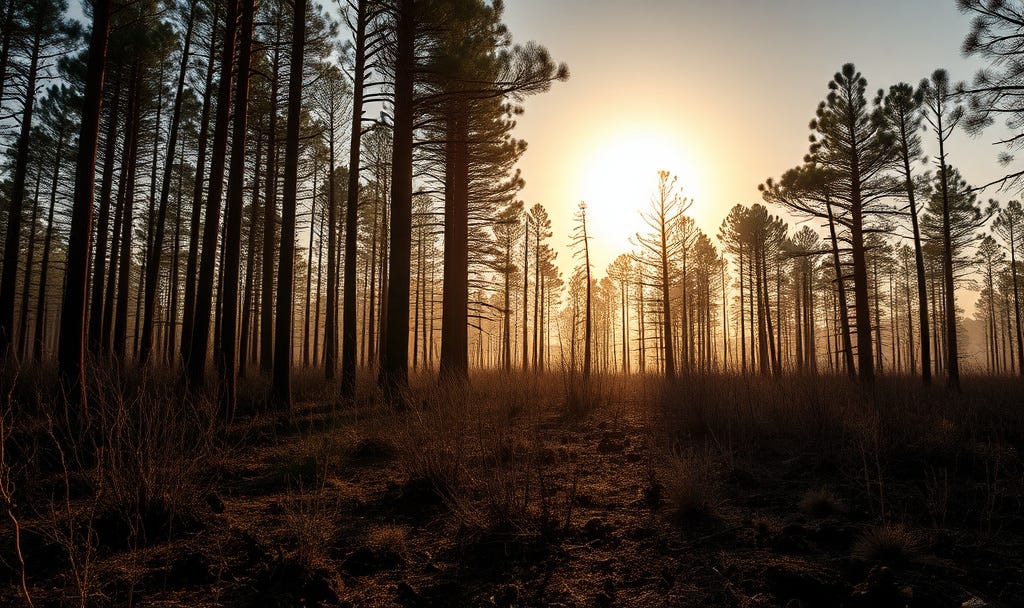
Picture a forest the morning after a fire.
The canopy is gone. The shrubs are gone. The ground is black, the soil exposed to open sky for the first time in decades, maybe centuries. It looks, to the human eye, like destruction — like an ending, total and absolute.
It is not an ending. It is a reset.
Ecologists have a word for what happens next: succession. The process by which a disturbed ecosystem moves, stage by stage, back toward complexity. And what they have discovered — through decades of observation across forests, meadows, wetlands, and tidal zones on every continent — is that this process is not random. It is not chaotic. It follows a sequence of stages so consistent and predictable that an ecologist standing in that burned clearing can tell you, with reasonable confidence, what will be growing there in two years, in five years, in twenty.
The ecosystem, in other words, knows where it is going. It has done this before.
The question worth asking is whether we have too.
The Stages of Return
Ecological succession moves in recognizable phases, each one creating the conditions that make the next possible.
The pioneer phase arrives first — fast-growing, opportunistic species that can tolerate exposure and scarcity. Fireweed. Bracken fern. Wind-seeded grasses. Nothing is established yet. Everything is raw potential. The pioneers are not building a permanent home; they are stabilizing the ground, adding organic matter, creating micro-conditions that will eventually make their own displacement possible.
By the early establishment phase, root systems are beginning to hold the soil. The ground is no longer bare but it is not yet a community. Things are forming beneath the surface, invisible, before they are visible above it.
Consolidation follows — the phase of competition and loss. Stronger plants begin to shade out the pioneers that made their arrival possible. This is the harshest phase of succession, the one that looks most like failure if you don’t understand what it is: the necessary death of what came first, making room for what comes next.
As complexity builds, shrubs arrive. Insects diversify. Birds follow the insects. The system develops texture and interdependence — layer upon layer of relationship that didn’t exist in the pioneer clearing.
Canopy closure shifts everything. When the first trees establish dominance and their crowns begin to touch, the light regime below changes dramatically. A new world is created in the understory, cooler and dimmer, hospitable to species that could not have survived in the open clearing.
The understory matures, filling in with shade-tolerant species. The forest develops memory — in its root network, in its seed bank, in the accumulated chemistry of its soil.
In old growth emergence, the oldest trees become mother trees, hubs of disproportionate influence, and the network deepens into something genuinely ancient.
The ecosystem approaches climax — its stable, complex endpoint. Not static, but dynamically balanced, capable of absorbing small disturbances without losing its essential character.
And then, climax: the fully realized community. Diverse. Resilient. The system at the height of its integration, until the next fire, the next flood, the next fallen giant opens a gap and the whole beautiful process begins again.
Nine stages. Each one arising from the last. In perfect succession.
The Pythagorean Nine
Pythagoras, who was as interested in the patterns of the natural world as he was in mathematics, understood nine as the number of completion — the final single digit, the place where a cycle fulfills itself before returning to one. In the numerological tradition that bears his name, human life moves through nine-year arcs, each year carrying a distinct quality of experience that mirrors, in the psychological realm, what succession enacts in the ecological one.
The nine Personal Years move like this:
Year 1 is the pioneer phase — initiation, new beginning, the bare ground after disturbance. Exposed, fertile, uncertain. Something has ended and something is beginning and they feel, uncomfortably, like the same thing.
Year 2 is early establishment — a time of patience and gestation, of things forming beneath the surface before they are visible. Relationships deepen. Roots go down. Nothing dramatic appears to be happening.
Year 3 is the first flowering — expression, creativity, the pioneer plants blooming. What was forming underground begins to show itself. There is energy here, joy, and also a certain “aliveness” here that transcends words. What was once below is now revealed as above.
Year 4 is consolidation — the hard, unglamorous labor of building structure. Root systems deepening. Work that is invisible but essential, the kind of work that will make everything that follows possible.
Year 5 is the canopy shift — change, disruption, the unexpected arrival of something that alters the light. What felt stable is suddenly in motion. This is not failure; it is the system moving into its next phase.
Year 6 is the understory filling in — responsibility, tending, nurturing what has been built. The care work of succession. Less dramatic than Year 5, but the system is quietly becoming more complex.
Year 7 is old growth emergence — a time of depth, solitude, and inwardness. The roots are going deeper than they have ever gone. This is not a year for external achievement; it is a year for the mycorrhizal network. The tree wants to go deeper into the soil to obtain knowledge of not only itself but its neighbors.
Year 8 is climax approach — harvest, power, culmination. What was planted in Year 1 is now fully expressed. The system is at the height of its capacity.
Year 9 is completion and release — the composting of the old, the clearing of the ground. Something is ending. The pioneer plants are dying back. The field is preparing itself, whether you are ready or not, for the next disturbance, the next beginning, the next Year 1.
Jung’s Succession
Carl Jung described the psychological journey toward wholeness as individuation — a lifelong process of integrating what is unconscious, encountering the deep patterns of the psyche, and developing a Self that is both genuinely personal and connected to something larger. He understood it, critically, as a process that moved through disturbance. Not despite crisis but through it.
The structural parallel to ecological succession is precise.
The persona — the adaptive self we build in early life to navigate the social world — is the pioneer species of individuation. It arrives first, it serves a genuine function, and it must eventually be displaced by something more complex. The persona does not fail; it succeeds so completely that it outlives its usefulness, and the psyche, like a maturing ecosystem, begins to shade it out.
The shadow encounter — Jung’s term for the confrontation with the disowned, rejected, and unacknowledged parts of the self — is the consolidation phase. It is the harshest passage in individuation, the one that most resembles destruction from the inside. What worked in early life stops working. The pioneer plants are dying. This is not a breakdown of the process; it is the process, doing exactly what it is supposed to do.
The Self — Jung’s term for the organizing center of the whole psyche, the state of integration toward which individuation moves — is the climax community. Not a fixed endpoint, not a state of permanent peace, but a dynamically balanced condition in which the full range of human experience can be held without the system losing its coherence.
Both succession and individuation move through loss as a generative force. The pioneer must be displaced. The persona must be outgrown. What feels, from inside the experience, like an ending is the ecosystem making room.
Why Nine

Why does a complete cycle require nine stages rather than seven or twelve?
In Pythagorean tradition, nine is the number of integration — the last single digit, the place where all that came before is gathered and completed before the cycle resets. There is a mathematical beauty to this: in digit addition, nine absorbs everything. Add nine to any number and reduce it, and you return to where you started. Nine changes everything and leaves the essence unchanged.
But the deeper answer draws from Jung himself, who was insistent that the psyche does not progress in a straight line. It moves in a spiral. You do not resolve a wound and leave it behind. You circle back to it — at a greater depth, with more of yourself available, capable of holding what you could not hold the first time. Each revolution of the spiral returns you to familiar terrain and finds you changed.
Nine is the number of that spiral’s completion. The cycle does not end at nine and return to zero — it ends at nine and begins again at a higher level of integration, the way a river returns to the sea not as the same water but as water that has traveled, that carries sediment and memory and the chemical signature of everywhere it has been.
This is what distinguishes the nine-year arc from simple repetition. The burned forest that undergoes succession a second time is not the same forest that underwent it the first time. The soil holds the biological memory of the previous cycle — a richer seed bank, a mycorrhizal network already partially intact, a microbial community that knows how to respond. Recovery is faster, deeper, more resilient. The forest begins again, but it does not begin from nothing.
The psyche works in a similar way. The person entering a new Year 1 after completing a full nine-year arc is not the same person who entered the last one. They carry the integrated experience of everything the cycle brought — the losses of the consolidation years, the harvest of the climax years, the release of the ninth year’s composting. Individuation, Jung argued, is never finished. But it deepens. Each spiral of the journey returns you to the beginning with more of yourself intact, more capacity for complexity, a greater ability to hold what once would have shattered you. The ground remembers.
Likewise, you also have the same capability to remember your past and what you gained from it. That is, if you think deeply, like the plants do with their roots, and not see yourself as a victim of the past but rather a co-creator of it. Numerology can help us think more deeply about past experiences and what possible lessons apply to those experiences. The Universal Day Number and/or Personal Day Number can be applied here to provide personal Tarot readings by yourself or even used without Tarot to provide a general feel for what the date represented in your life story.
Reading Your Own Terrain
To find your current Personal Year, add your birth month, birth day, and the current year together, then reduce to a single digit. If you were born on March 15, for example: 3 + 1 + 5 + 2 + 0 + 2 + 6 = 19, reduce to 1 + 9 = 10, reduce to 1 + 0 = 1. A Year 1 — pioneer phase, new beginning, bare ground after disturbance.
Knowing you are in a Year 4 is like knowing you are in the root-establishment phase of succession — the work is not glamorous, it is not visible above the surface, and it will not produce the flowering that Year 3 offered or the harvest that Year 8 promises. But it is the work that makes those years possible. Without it, the structure collapses. Knowing what phase you are in doesn’t change the work; it changes your relationship to the work. It transforms what felt like stagnation into deep establishment. What felt like limitation into necessary consolidation.
This is what symbolic systems like tarot and numerology, at their best, actually do. Not predict the future. Orient you in the present. Give you language for the terrain you are already moving through.
The Ground Remembers
Go back to the burned forest.
The ground is black. The canopy is gone. The pioneers are already arriving — the fireweed pushing through ash, the grasses seeding in on the wind. Beneath the surface, the mycorrhizal network that survived the fire is already routing nutrients toward the new growth. The seed bank, dormant for decades, is responding to the sudden light.
The ecosystem is not starting over. It is starting again — from a substrate richer than the one that existed before the fire, carrying the biological memory of every succession it has ever completed.
The same is true of the psyche. Every nine-year arc begins from the ground of everything that came before. The new Year 1 is not a return to the beginning. It is a spiral upward from a deeper root system, with a richer seed bank, with the mycorrhizal network of every relationship and integration and loss already woven into the soil.
You are not starting over either.
The question is not whether you are in a cycle. You are, as surely as any forest after a fire. The question is whether you are reading the terrain. Whether you can tell the difference between the death of pioneer plants and the death of the forest. Between necessary loss and actual ending. Between the bare ground of a Year 9 clearing, and the bare ground of a Year 1 that is already, beneath the surface, full of what comes next.
The ground remembers. The seed bank is patient.
Something is already on its way.
To find your Personal Year, add your birth month + birth day + current year and reduce to a single digit. What phase are you in? I’d love to hear what resonates — or what doesn’t — in the comments.