
The Four Elements are Not Metaphors
An archetypal map of New Earth: As within, so without. As above, so below.

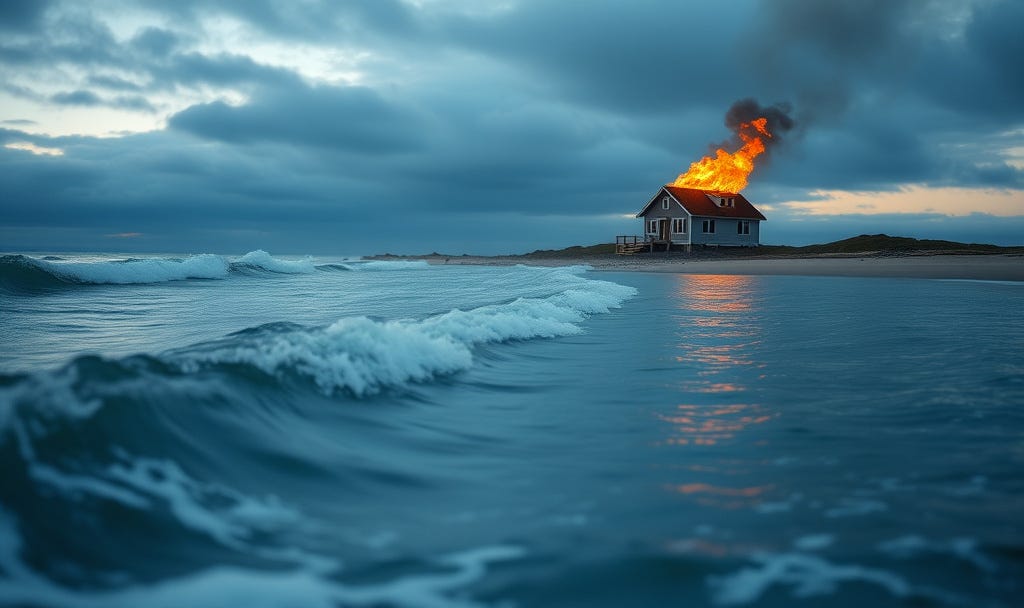
You’ve probably seen the four elements show up in some spiritual context and quietly filed them under “interesting but not serious.” Fire, Earth, Water, Air — they show up in astrology, in tarot, in New Age circles, in fantasy novels. They have a certain appeal. But as a framework for understanding reality? Most of us quietly assume we’ve outgrown that. We have the periodic table now. We have quantum mechanics. We know what things are actually made of.
But here’s the interesting follow up: what if the people who developed the four-element framework weren’t trying to do chemistry? What if they weren’t making claims about the composition of matter at all — but about something else entirely? Something that chemistry or physics doesn’t actually address?
The four elements, I argue, are not a primitive attempt at science. They are an archetypal map of experience — specifically, of the four fundamental modes in which the Earth presents itself to a conscious being who is actually paying attention to it. And when you start looking at actual ecosystems through that lens, something quietly remarkable happens. The map starts to fit.
Fire: The Darkness

Let’s start outside, because that’s where the argument is most grounded.
Fire is not just a symbol of transformation. It is an actual ecological force — one that entire landscapes have evolved around, depended on, and been shaped by over millions of years. Let’s take a longleaf pine savannah — this is an ecosystem that doesn’t just survive fire. It requires it. Take fire away and it collapses into something else entirely, usually something less diverse, less resilient, less alive in the specific way they were designed to be alive.
Pyroecology — the science of fire as an ecological process — has spent decades documenting something that Native American tribes understood intuitively for thousands of years: fire is not destruction with occasional unfortunate consequences. It is transformation. It breaks down accumulated structure, releases nutrients locked in dead material, opens canopy for light-dependent species, and creates the conditions for entirely new communities of life. Certain pine cones won’t even open without heat. Certain wildflowers only germinate in ash.
This is not metaphor. This is ecology. Fire is a genuine mode of existence in the living world — characterized by transformation, by the release of what was once locked, by the generation of possibility through the destruction of existing structure. When the ancient world looked at fire and said this is one of the fundamental modes of reality, they were observing something real. Not in the “burning fires of hell” sense that the ego often tells us, but in the sense that rebirth requires transformation.
Shadow work according to Carl Jung requires the fire, in a strictly symbolic sense. It requires that we not think in that way and instead see the darkness as part of the contrast that makes life worth living. The fire often invites “hell” imagery but really it is a process of evolution, not condemnation.
Earth: The Logos

A teaspoon of healthy forest soil contains more living organisms than there are human beings on Earth. The root network threading through that soil connects individual trees across acres of forest — sharing carbon, passing stress signals, routing nutrients toward seedlings that couldn’t survive alone. The forest you see above ground is, in a very real sense, the surface expression of a community that exists primarily underground.
Earth ecosystems operate differently from fire in ways that go beyond the obvious. Where fire moves fast, earth moves slow. Where fire releases, earth accumulates. Where fire destroys, earth builds up. Healthy soil is not a substrate — it’s a record of history, encoding millions of years of ecological relationship in its structure, its chemistry, its microbial communities. Destroy it and you haven’t just removed a growing medium. You’ve erased a library.
The mode of existence that Earth embodies in the living world is structural, patient, accumulative, and embodied. It is the element of what persists, what holds, what builds complexity through incremental addition rather than dramatic transformation. The ancient philosophers looked at earth and said: this too is a fundamental mode of reality. The soil scientist looking at a healthy soil profile three thousand years later is seeing the same thing.
This is what might be called the Stone energy, the Logos or “divine masculine energy” in New Age terms. The Earth element is what gives the words “truth” and “reality” absolute meaning. It also tells living things what is up, down, left, and right. In space, spatial directions would not exist at all. The gravity is what makes us more “down to earth” both literally and figuratively in terms of knowing that all actions we take (or not take) can make us more or less safe from bodily harm.
Water: The Eros

The hydrological cycle is the planet’s circulatory system — moving nutrients from mountains to oceans, regulating temperature across continents, carrying the chemical signals that allow separated ecosystems to participate in the same global processes. Water doesn’t just support life. In a very real sense it is the medium through which the living world communicates with itself.
The diversity of water ecosystems is staggering but what runs through all of them, the quality that makes them recognizably watery, is this: they are ecosystems of depth, of flow, of connectivity. Water carries things. Water holds ice cubes together. Water has a surface that reflects and a depth that conceals. The most biologically rich aquatic environments tend to be the ones where depths and surfaces interact — estuaries, wetland edges, the thermocline where warm surface water meets cold deep water.
When the ancient world identified water as a fundamental mode of reality, they were pointing at something genuine: the flowing, connecting, depth-holding, surface-reflecting quality that appears in rivers and in the ocean and in the way watersheds function as integrated systems with their own memory and their own intelligence. When this same concept is mapped to the human psyche, it is understood as the flow state, Eros, or divine feminine energy.
Air: The Mind

The atmosphere is not the background of life. It is an ecosystem in its own right — think about the birds and butterflies around us. The aerial ecosystem also connects things that nothing else can connect. A monarch butterfly navigating from Canada to Mexico is using the atmosphere the way a fish uses the ocean — as the medium that makes movement, relationship, and distribution possible.
What makes air ecosystems distinct from the other three is their speed and their reach. Where earth operates on geological timescales and water operates on hydrological ones, air operates on meteorological ones — hours, days, seasons. Weather is the atmosphere thinking out loud, processing information from across the planet and producing local responses. The same atmospheric circulation that brings rain to a forest carries dust from the Sahara to fertilize the Amazon. Everything in the air is, in some sense, in communication with everything else.
The ancient world recognized air as the element of communication, of boundary-crossing, of the rapid distribution of information through a medium that is everywhere simultaneously. They were describing the atmosphere before they had the word for it. The mind, as we understand it, would not have meaning if we did not communicate using language. In that case, though, our thoughts would not be private anymore. We would have a shared mind. The Mind of God or “Holy Spirit” in Christian theology is often attributed to this element.
The Psychology That Matches
Here is where it gets interesting.
Carl Jung spent decades in clinical practice observing how different people characteristically engage with experience. Not what they experience, but how — the fundamental mode through which they take in and process reality. After years of observation he identified four irreducible psychological functions: Sensation, Feeling, Intuition, and Thinking.
Jung did not derive these functions from the classical elements. He derived them from watching people. From noticing that some patients consistently engaged with experience through direct physical perception, others through emotional evaluation, others through the perception of possibilities and future implications, others through logical analysis and pattern recognition. He arrived at a fourfold map through empirical observation of the psyche.
And then — if you hold his four functions next to the four elements — something quietly remarkable happens.
Sensation is the psychological function of direct physical perception — the immediate, embodied, sensory engagement with what is actually present. It is the function that is most at home in the body, most grounded in the given, most attentive to the texture and weight and solidity of actual experience. This is the Earth mode — structural, patient, embodied, present to what is rather than what might be.
Feeling — which Jung used not to mean emotion exactly but the function of relational evaluation — is the psychological function of connection, of the quality that flows between things rather than residing in them individually. This is the Water mode — flowing, connecting, holding depth beneath its surface, the medium through which meaning moves between people and between a person and their world.
Intuition is the function of perception beyond the given — the ability to sense possibilities, implications, and future developments that are not yet present in direct experience. It is the function that leaps, that sees around corners, that generates new possibilities by breaking down existing structures of thought. This is the Fire mode — the function that burns through the existing structure so a new timeline can be born. Not in a chaotic way like feelings do to us, but a way that has logical boundaries.
Think of it like a pellet stove in your home. The air inside it is contained and the heat we receive from it can be controlled. On social media, we are often not in touch with our intuition at all or we confuse it with our feelings. But feelings that are not controlled can be thought of as a thunderstorm in your mind, suffering occurs temporarily but no growth comes from it. That only comes with thinking.
Thinking: the function of logical analysis, pattern recognition, and the structuring of experience through concept and language. It is the function of communication — of taking experience and rendering it into transmissible form. This is the Air mode — communicative, boundary-crossing, the rapid distribution of structured information through the medium of language and logic.
Jung arrived at the same four modes that ancient observers of the natural world arrived at — through a completely different method, starting from a completely different direction. One tradition started outside, looking at the living world, and identified four fundamental modes of existence. Another started inside, observing the psyche in clinical practice, and identified four fundamental modes of engagement. They met in the middle at the same fourfold structure.
This is not coincidence. It is convergence — the signature of two independent inquiries arriving at the same underlying reality.
What We Lose By Calling Them Metaphors
When we relegate the four elements to metaphor — when “fire is passion” becomes just a figure of speech rather than a genuine claim about a shared quality appearing at different scales — we sever something important.
The connection between the transformative dynamic of an actual wildfire and the transformative dynamic of genuine psychological change is not poetic decoration. They share an essential quality. The fire in the ecosystem and the fire in the psyche are both real expressions of the same mode of existence — the mode characterized by transformation, by the release of what is locked, by the generation of new possibility through the burning away of existing structure.
The cost of losing this is not just poetic. It is practical and it is ecological. A civilization that has intellectually demoted the four elements to figures of speech has simultaneously lost two things: its felt relationship with the living world, and its felt relationship with the depths of its own psyche. Because these were always connected through the elemental framework. The outside and the inside were always being read through the same map.
What we call ecological disconnection and what we call psychological disconnection are, at this level, the same disconnection expressed in Hermeticism as the concept of “As within, so without.”
An Elemental Inventory
Before you finish reading this I want to suggest something practical. Not a personality quiz. Not a typing exercise. Just four questions — one for each element — that are worth sitting with honestly.
And if you can, sit with them outside. In the presence of actual wind, actual soil, actual water, actual warmth. Because the living elements may offer something to these questions:
Fire: Where in your life do you experience genuine transformation — the burning away of what no longer serves? Where do you feel the pull toward transformation and find yourself resisting it anyway?
Earth: Where do you feel genuinely grounded — in your body, in your relationships, in your physical place in the world? How long has it been since you had your hands in actual soil?
Water: What moves through your life that you trust without fully understanding? What depths in yourself — emotional, psychological, relational — do you tend to avoid?
Air: How clearly can you observe your own thinking? What ideas are you living inside right now that you’ve never actually examined?
Notice which question feels easy and which feels uncomfortable. The uncomfortable one is probably pointing somewhere worth going. Feel free to comment down below so we can grow this community here. Every interaction helps.
The World Is Still Made of These Things
The ancient philosophers who organized their understanding of reality around Fire, Earth, Water, and Air were not doing primitive chemistry. They were doing something more subtle and in some ways more difficult — they were mapping consciousness using four archetypes to describe the physical dimension and how it is experienced here on this planet.
They were right. Not in the way chemistry is right, but in the way a good map is right — not a perfect picture of the territory, but a reliable guide to navigating it.
The living world is still organized around these four modes. Ecosystems of transformation and ecosystems of structure, ecosystems of depth and connectivity and ecosystems of communication and distribution — fire and earth and water and air, operating simultaneously, in relationship, in the landscape outside your window right now.
And so are you. Four modes of engaging with reality, four ways of being present, four dimensions of experience that are all available to you. The “New Earth” term in Pythagorean numerology contains, ironically, a Destiny Number of 4 and this may or may not be coincidental. If the 4 elements theory by the ancient philosophers was accurate in a symbolic way, I’d say this follows the same pattern and that we are destined to learn this:
“As within (1=Air), so without (2=Water). As above (3=Fire), so below (4=Earth)”. I’ll now use logic and reason (Air connects what we call “logic” with “a reason”) to communicate to you that the four elements are not metaphors, they are coded instructions on how to heal our planet. That statement comes from logic and the reason it might be true comes from above and around us.
Air happens to have a Destiny Number of 1 which matches that of the words “logic” and “Satan.” But “logic and reason,” the highest form of thinking that speaks using both words and mathematics tells us this general statement about reality:
“As above, so below (3).
As within, so without (1)”
Can you guess the Destiny Number of “logic and reason”? If Satan represents the Shadow, embracing logic and reason represents shadow work. It means casting light (Destiny Number 2) on the darkness (Destiny Number 1). And when we integrate 2 and 1, we get Number 3. That is the Destiny Number of the bold quote above using the system of Pythagorean numerology. It is between 1 and 4. The here (1), there (4), and space between (3). That space between is what Carl Jung called “shadow work.”
This concept can be understood in a “down-to-earth” way through clinical psychology or in a “higher” religious way by referring to angels and demons, but both are pointing to the same truth. If you draw lines connecting the quotes, you will get a rectangle with four sides. These represent, in my opinion, the four elements and show (literally) that they are not just metaphors but a reflection of this esoteric concept.
If this kind of deep thinking interests you — the place where inner landscape meets outer one — consider subscribing. Even just liking or commenting on my posts is greatly appreciated.