

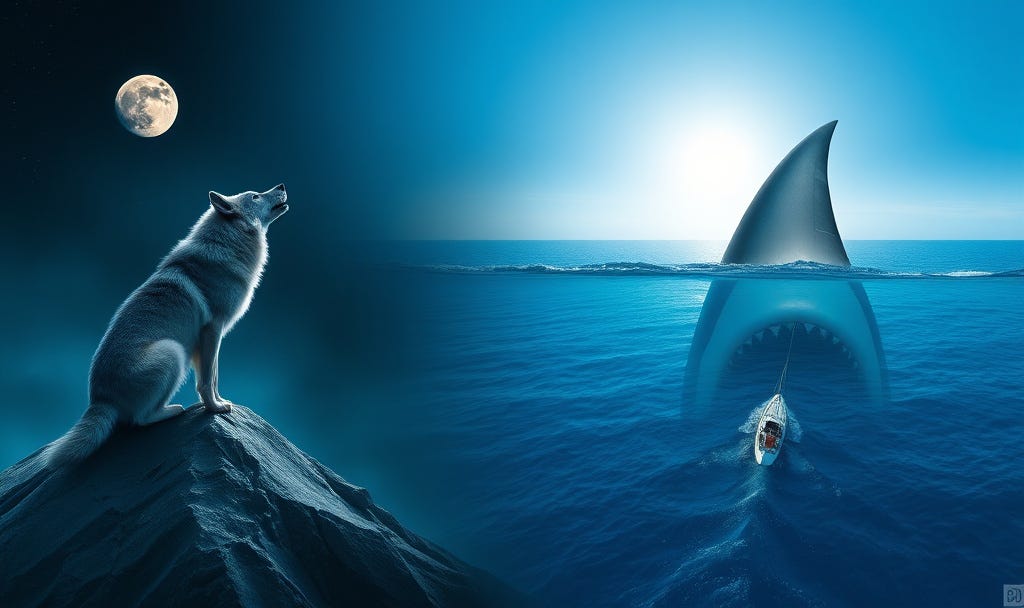
The first time you see a large predator in the wild, something happens in the body before the mind has time to respond.
Not panic, necessarily. Not the cinematic freeze of a horror film. Something older and more interesting than either: a full-body aliveness, every sense sharpened, the sudden awareness of being seen by something that does not need you and does not fear you. The ordinary noise of conscious thought goes quiet. You are, for a moment, entirely present and attuned to the senses.
Most people who have had this experience describe it as one of the most vivid of their lives. And most of them, in the same breath, describe wanting to destroy the thing that produced it.
This is the paradox at the center of our cultural relationship with apex predators. We are simultaneously fascinated and terrified, drawn and repelled, devoted to their imagery — wolves on sports jerseys, sharks on film posters, eagles on national seals — while systematically eliminating their actual populations from the living world. We worship the symbol and destroy the animal. This isn’t a coincidence, it has to do with psychology and in this article, we will explain how this connects to Jungian archetypes as well as what that tells us about the process of shadow work.
Case Studies: Wolves and Sharks

Carl Jung observed that the more completely a quality is suppressed, the more dangerous it becomes in projection. A civilization that has spent centuries systematically suppressing its instinctual nature does not produce a neutral attitude toward wolves. It produces fairy tales in which they devour grandmothers. It produces bounties, poisoning campaigns, and the near-total elimination of wolf populations from the continental United States by the 1930s. We are not kind to wolves even though they have done nothing to us.

And it produces Steven Spielberg’s Jaws — a 1975 film about a great white shark terrorizing a beach town that became one of the highest-grossing movies in history, not because sharks were actually killing people in unusual numbers, but because the film gave a shape and a set of teeth to something audiences were already carrying inside them. The shark didn’t need to be realistic to be terrifying. It needed to be the right mirror to be entertaining and terrifying.
Anyone heard of Shark Week? That’s a summer tradition on television for a reason. In the years following the Jaws film’s release, recreational shark hunting surged across the United States. Great white populations, already under pressure, declined further. A movie about a monster had produced a hunting season — because the monster was never really about the shark. It was about our own shadow’s tendency to demonize that which we fear and sometimes even to profit from its elimination.
The Shadow We Cannot Acknowledge
Jung’s concept of the Shadow describes the repository of everything the conscious self has rejected — the qualities, impulses, and potential actions deemed unacceptable and pushed below the threshold of awareness. The Shadow is not only dark. It contains suppressed power, instinct, and vitality as much as it contains aggression and destructiveness. It is everything that did not fit the identity we constructed, the self we decided to become.
What the Shadow cannot do is disappear. Suppressed content does not dissolve — it migrates outward, attaching to whatever screen is available. Other people. Other groups. Other species. This is projection: the psychic mechanism by which what we cannot acknowledge in ourselves becomes what we see, and fear, and persecute in the world outside us.
The apex predator is the perfect Shadow screen.
It embodies the qualities that civilized human identity has most systematically disowned. Unapologetic hunger. Physical power. A relationship to instinct so complete that there is no gap between impulse and action.
Which is exactly what we have spent centuries telling ourselves we must not be — and exactly why the wolf, the shark, and the bear have functioned so reliably as screens onto which that suppressed wildness gets projected.
What Yellowstone Taught Us

In 1995, after a seventy-year absence, wolves were reintroduced to Yellowstone National Park. What followed became one of the most documented ecological events in modern conservation history — and one of the most psychologically instructive.
Without wolves, Yellowstone’s elk population had grown unchecked. Elk grazed freely along riverbanks and in open valleys, stripping vegetation, destabilizing stream banks, simplifying the plant communities that dozens of other species depended on.
The wolves did not simply reduce elk numbers. They transformed elk behavior. Elk stopped grazing in the open valleys and along the riverbanks where predation was most likely. Vegetation recovered in those areas. Roots stabilized the banks. Rivers narrowed and deepened, their courses becoming more defined. The physical geography of the park began to change in ways no one had fully anticipated.
Ecologists called it a trophic cascade. The wolves changed the rivers — not primarily by killing the elk, but by making them afraid.
This is the key insight, and it has implications that extend well beyond ecology. The wolf’s most important contribution to Yellowstone was not what it killed but what it caused every other species to reckon with. The intelligence of appropriate fear — the productive, behavior-restructuring force of predation pressure — was what the system had been missing. An ecosystem without apex predators is a system that has lost one of its most essential feedback mechanisms. Everything proliferates without limit.
No boundaries exist without the possibility of what we will call “appropriate fear.” Subconscious fear that exists to keep us safe in our physical bodies, for both animals as well as ourselves. For humans, this same feeling encourages us to use our minds instead of acting like wild animals. This is the basis for all the legal systems we have today. This feeling is not productive by itself, but it is instructive as it points us to who we really are in comparison to the animal kingdom.
What Was Lost When We Cleared the Wild
Wolves were eliminated from most of their historic range in the continental United States by the 1930s. Shark populations have declined by as much as 70% globally in recent decades. Mountain lion ranges are fragmented and shrinking. Bears have been disappearing from vast portions of the landscapes they once structured. The beloved lion, Panthera leo, has disappeared from Eurasia and is shrinking in population globally due in large part to “trophy hunting.”
The ecological consequences follow the Yellowstone logic in reverse: remove the apex predator and the system destabilizes. Mid-level predators explode in population. The removal of sharks from marine systems triggers cascading collapses of fish populations that human fishing pressure then accelerates. Simpler, less resilient, more vulnerable to disruption — this is what an ecosystem without its predators becomes. It impacts our own food security in the long term.
The consequences extend further than most people realize — into the atmosphere. In Yellowstone, the return of wolves triggered the recovery of riparian vegetation and the return of beaver populations, whose dams create wetland habitats that store carbon, regulate water flow, and cool stream temperatures in ways that buffer against drought. Apex predator recovery, in this example, is not separate from climate resilience — it is one of its structural preconditions. Our own predatory nature is actually accelerating the rate of climate change not because we had to eliminate these mammals in order to eat, but because of our unwillingness to address the shadow within ourselves.
Meeting What We Fear
The Jungian path through the Shadow is not elimination but integration — bringing what has been unconscious into conscious relationship, not so that it takes over but so that its energy becomes available rather than consuming.
This distinction matters enormously. Integrating the Shadow does not mean acting out its contents. The person who integrates their capacity for anger does not become more violent — they become less controlled by violence, because they are no longer managing the constant pressure of what they cannot acknowledge. In other words, they are balancing their mind with their feelings.
What apex predators actually embody — encountered directly, without the distortion of projection — is not evil but ecological intelligence. Precision. Economy of effort. Total attunement to the immediate environment. The willingness to act from instinct without apology. These are not qualities to be feared. They are qualities that can be called “authentic” to the species and maximizes chances of survival over the long term. An animal’s authentic self is obviously quite different from our own but they do teach us that if they can act authentically in a way that is courageous, so can we.
The predator, in this sense, is not an enemy. It is a mirror of what we have hidden. What it reflects is the wild, instinctual self that when integrated with the mind and soul gives rise to what can be called our “authentic self.” This is the self that emerges from the shadow work process.
How We Help the Animal Kingdom

The conservation of apex predators will not be achieved by ecology alone. As long as the wolf carries our projected Shadow, we will find reasons — livestock, safety, competition for resources, even hunting for profit — to justify its elimination. The policy arguments will continue to lose to the fear, because the fear is not really about wolves.
What is needed alongside the science is the psychological work — individually and collectively — of withdrawing the projection. Of meeting what the predator actually is rather than what we fear it can represent to us if not controlled.
From a political perspective, several things can be done including:
Supporting apex predator recovery and reintroduction — wolves in the American West, sharks in marine protected areas, mountain lions in fragmented habitat corridors — is not only ecological stewardship. It is an act of collective Shadow integration: restoring to the landscape the feedback mechanism we removed when we could not tolerate what it represented.
Monitoring the health of vulnerable populations: The health of apex predator populations is a direct ecological measure of ecosystem resilience. It can also be a measure of our willingness to live in honest relationship with the full complexity of the natural world — including the parts that frighten us.
Challenging the cultural narratives that maintain the projection matters just as much as the policy work. The fairy tale wolf. The monstrous shark. The dangerous bear near a campground. These are not innocent stories — they are the cultural infrastructure of Shadow projection, and they shape legislation, management policy, and public tolerance for predator populations in ways that have measurable ecological consequences. Replacing them with ecological literacy, with genuine encounter, with the story of what wolves actually did to the rivers of Yellowstone, is conservation work that has positive ripple effects globally.
Applying This in Daily Life
I’m not a religious Christian but one of my favorite verses of the Bible is Matthew 7:1 where Jesus teaches:
“Do not judge, or you too will be judged.”
This is a statement of truth, not of religion by itself. Religion seeks blind faith, but the truth of any matter is found from faith (“trust”) and reason combined. We can find reasonable evidence in this article to support the claim that our relationship with apex predators often shows a subconscious tendency to judge others, both people and animals. But judgment often creates more problems than solutions.
It reflects a mindset of separation from nature and that is simply not true. We are in fact interconnected with nature according to science, and that never changed. What’s changing is hopefully our ability to perceive this as reality.
The Shadow does not require wilderness access to work with. It is present in every reaction that seems disproportionate to its trigger, every quality you find yourself judging harshly in others, every species or type of creature that produces an aversion stronger than the actual threat it poses.
Notice what you fear or despise in the natural world — the spider, the snake, the predator, the scavenger. Ask, without needing to answer immediately, what quality that creature carries that you have been taught to reject. This is Shadow work in its most accessible form: the natural world as a library of everything we have projected outward, waiting to be reclaimed.
Practice the intelligence of appropriate fear in the event you find yourself face-to-face with an apex predator in the wild. The goal is not the elimination of fear — it is basically making it so we think more logically next time, respect the free will of others, and don’t encounter as many fearful situations.
Appropriate fear — the kind that sharpens attention, restructures behavior, and restores the feedback mechanism that keeps a system honest — is not the enemy of wellbeing. Its absence is.
At the end of each day, note one thing you avoided, one thing that produced a reaction disproportionate to its cause, one quality you found yourself judging harshly in another person or in the living world around you. These are the coordinates of the Shadow.
The Wolf at the Edge
Return to the opening moment: the predator, the full-body aliveness, the sense of being seen as vulnerable.
The wolf at the edge of the forest is not your enemy. It is the ecosystem’s most important feedback mechanism — the intelligence that keeps every other part of the system honest. The stories that made it a demon said more about the storytellers than about the wolf.
The same is true of the Shadow. The qualities we have feared and suppressed and projected outward are not the worst of us. They are often the most alive parts of us — the instinct, the power, the wildness, the capacity for full presence that our civilization has slowly disowned.
The rivers changed when the wolves came back.
The psyche changes the same way — not when we defeat what frightens us, but when we finally stop running from it long enough to see what it actually is.
Here’s a question to ponder:
When you really look into the eyes of a dog, don’t you see a reflection of you? Now look into the eyes of a wolf, if you are lucky enough to see one up close. You would see a reflection of you staring back. These are two reflections of humanity, one domesticated and one wild. One controlled and one wild and free. We see dogs as angels only because they are bred by us and submissive to us. It is not a coincidence why we often see wolves in the opposite way.
Wolves are in fact bigger, and the parent species of domestic dogs. If humanity is the dog in this metaphor, Mother Nature represents the collective Wolf archetype. Not the Lone Wolf archetype that we idolize so much in Western culture, but the natural one that has a family just like we all do. We are all part of the same family.
What predator or creature in the natural world has always produced a strong reaction in you — fascination, fear, aversion, or something harder to name? I’d love to hear what comes up in the comments.