
As the Root, So the Branch
Part I: On the Hidden Unity of Hermetic Philosophy, Jungian Psychology, and the Living World

There is a scene early in the film The Matrix where Morpheus sits across from Neo in a leather chair and asks him a question that has no comfortable answer.
“Have you ever had a dream that you were so sure was real? What if you were unable to wake from that dream? How would you know the difference between the dream world and the real world?”
Neo has no answer. Neither does the audience. And that discomfort — the sudden vertigo of not being able to prove that what you are experiencing corresponds to anything real — is not science fiction. It is one of the oldest philosophical questions in the Western tradition. It is, in fact, the founding question of a philosophical system called Hermeticism.
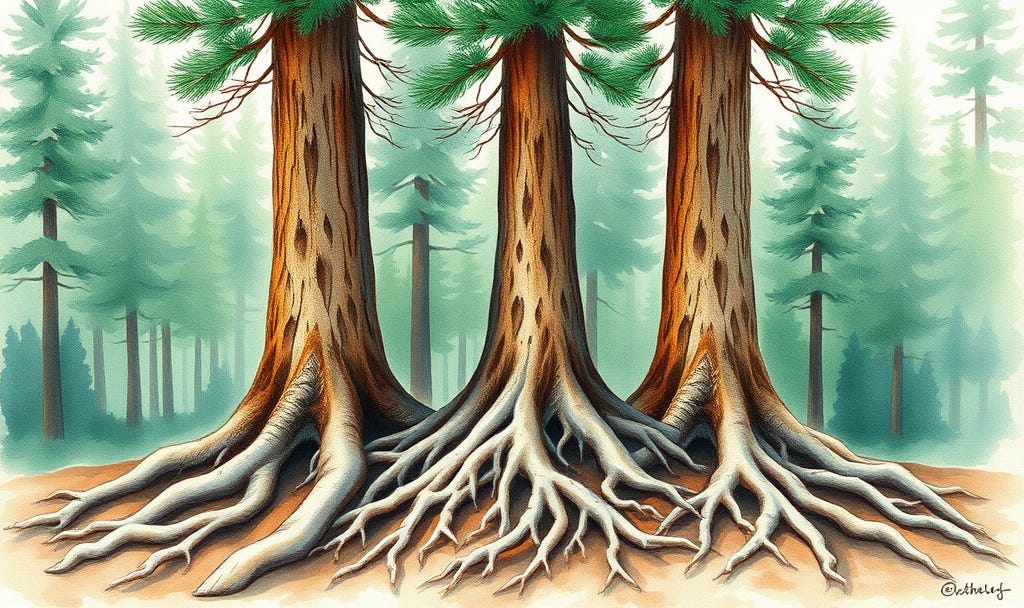
But The Matrix gave us a technological parable for something the natural world has been demonstrating all along. You only need to stand at the edge of an old growth forest and notice that the branching pattern of the canopy above your head is actually identical to the branching pattern of the root system beneath your feet. That the mycorrhizal network threading through the soil mirrors the neural network threading through the brain. That the spiral of a nautilus shell follows the same mathematical proportion as the spiral of a hurricane seen from space.
As above, so below. Not as metaphor. Not as philosophy. As science.
This is the foundational principle of Hermeticism — the philosophical tradition the producers were consciously drawing on when they made The Matrix — and it is the tradition that Carl Jung spent the last three decades of his career discovering. The strange symbolic imagery of the alchemical and Hermetic traditions — the prima materia, the stages of the Great Work, the Philosopher’s Stone — was not medieval superstition but a map of the interior territory Jung had been charting through forty years of clinical observation of the unconscious.
Two traditions. Four centuries of separation. The same map of the unconscious.
That is what this essay is about — and why it matters for anyone trying to understand what a tarot deck rooted in ecological science and Jungian psychology is actually doing. We are merging art and science into a system that is logically coherent and grounded in the truth that humans and nature are interconnected. And that humanity’s reconciliation with nature starts with changing hearts and minds. It requires us to wake up from the dream of separation.
What Hermeticism Actually Is
Hermeticism is a philosophical system rooted in a collection of texts known as the Corpus Hermeticum — dialogues attributed to a legendary figure called Hermes Trismegistus, the Hermes, understood as a synthesis of the Greek god Hermes and the Egyptian god Thoth. The texts were written in the early centuries of the Common Era, drawing on Neoplatonism, Egyptian religious thought, and early Gnostic philosophy.
At the center of the entire tradition is a single axiom, called the Law of Correspondence, drawn from a text called the Emerald Tablet:
As above, so below; as within, so without; as the universe, so the soul.
The axiom claims that reality is structured by correspondence — that the macrocosm and the microcosm mirror each other. In this case, we can say that the structure of the cosmos is reflected in the structure of the unconscious. To know what you are made of is to know what the world is made of. To understand the patterns of your own subconscious mind is to understand the patterns that organize the living world around you.
The natural world enacts this axiom in a way no philosophy text can match. The mycorrhizal network beneath a forest — the underground fungal web through which trees share carbon, transmit stress signals, and support their most vulnerable members — is a literal demonstration of as above, so below: the invisible underground structure sustaining the visible above-ground community.
The Hermetic Order of the Golden Dawn — the late nineteenth century esoteric society— synthesized Hermetic philosophy, Kabbalah, and astrology into a working system that was incorporated into the tarot. The tarot’s Major Arcana sequence, as the Golden Dawn structured it, is a Hermetic map: each card a stage in a journey of correspondence between the outer world of natural and cosmic pattern and the inner world of psychological transformation.
Every card in the Ecotone Anima deck will draw on this correspondence — the ecological image on the surface corresponding to the psychological reality beneath it, as above so below enacted in symbol and illustration.
What Jung Was Actually Doing
Carl Jung did not set out to rediscover Hermeticism. He set out to understand what his patients were dreaming.
What he found, after decades of clinical work, was that the unconscious produced images that did not come from personal experience — they were symbols that appeared in similar ways, across multiple patients, in many parts of the world.
Jung called the layer of the psyche that produced these images the collective unconscious — the shared substrate of human experience that underlies the personal layer of memory and repression, structured by universal patterns he called archetypes. An earlier essay in this series explored the mycorrhizal network as a physical version of exactly this structure: the underground web through which separate trees participate in a collective intelligence, sharing resources and information across what appears from above to be a collection of separate organisms.
Jung’s collective unconscious is the same structure in the interior world — a shared field of consciousness that connects individual psyches to a pattern larger than any of them, invisible from the surface but essential to everything growing above it.
Connecting to Alchemy
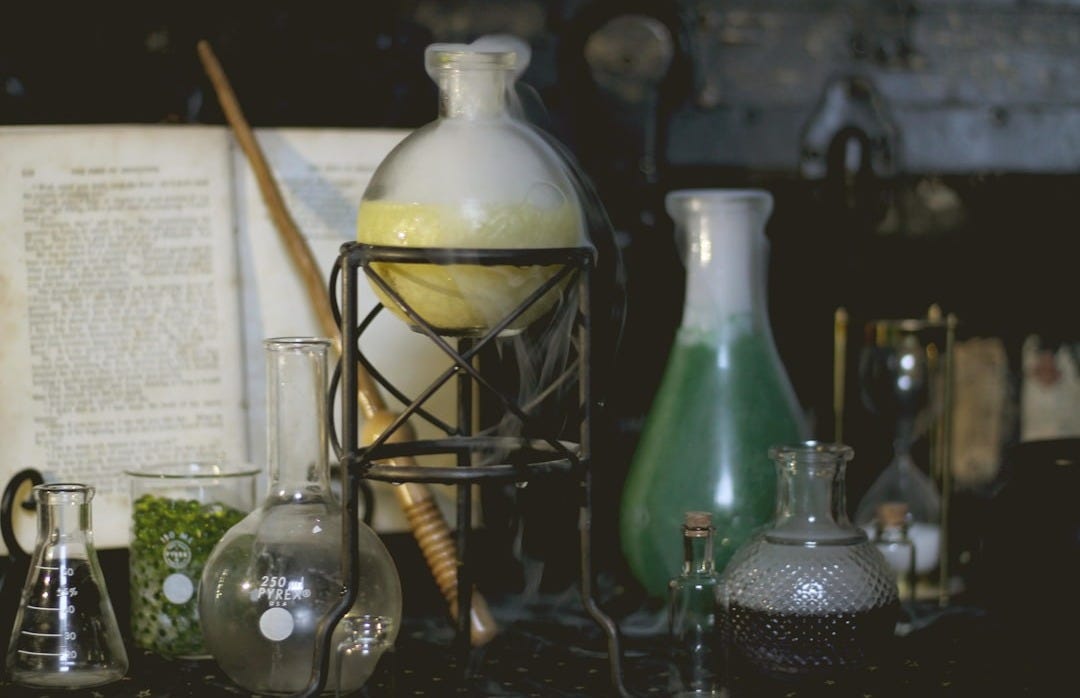
This framework brought Jung into direct confrontation with a question he had been avoiding: if the collective unconscious produces universal symbolic images, where had those images appeared historically? The answer arrived in his library in the form of a sixteenth century alchemical text called the Rosarium Philosophorum — strange woodcut images depicting kings and queens, serpents and suns, death and resurrection, the dissolution of bodies and their reconstitution in gold. Jung’s first reaction was that it was medieval nonsense. His second reaction, arriving slowly over years of study, was that he recognized every image from his patients’ dreams.
The alchemists, working four centuries before Freud named the unconscious, had been projecting the individuation process onto matter and trying to transform lead into gold. They were not trying to make literal gold in the way we think of it today. They were doing psychology in the only language available to them: fire and metal, sulfur and mercury, dissolution and reconstitution.
Jung concluded that alchemy was basically a primitive form of psychology that used symbols and art, as opposed to scientific principles, to map the psyche.
Three Correspondences
With both traditions on the table, the correspondences between them can be drawn — not as loose analogies but as structural identities, the same territory described in two different languages.
The First Correspondence: As Above So Below
The Hermetic axiom holds that the macrocosm and the microcosm correspond — that the structure of the cosmos is reflected in the structure of the soul, and that this correspondence is not metaphorical but structural. The universe and the psyche are organized by the same underlying order.
Jung arrived at the same conclusion from the opposite direction. Late in his career he proposed a concept he called the psychoid unconscious — the recognition that the deepest layer of the psyche is not purely subjective but participates in the structure of physical reality itself. At this depth the boundary between inner and outer becomes permeable. The psyche does not merely reflect the world. It corresponds to it structurally, the way two tuning forks of the same pitch resonate across a room.
In New Age terms, one might say this metaphor aligns theoretically to the idea of the “Law of Attraction.” However, the Law of Attraction can also be somewhat misleading. If someone visualizes a wealthy life or a romantic partner and tries to do everything in their power to obtain that without thinking of others’ needs, many would ask ethical questions like: what is the role of compassion, free will, and heart-centered behavior? And should we really “manifest” things from a place of pride? If so, isn’t that more like the opposing idea of: “I’m above, your below” ?
This subconscious belief is what the ego’s dream of separation is based on.
In short, one can believe in synchronicities and the collective power of people to create reality while dismissing the popular self-centered view of the LOA. When humility and pattern recognition go together and one is mainly focused on inner peace in the present moment despite the external reality, synchronicities can help confirm we are heading towards a more desirable timeline.
The empirical evidence Jung offered was, in fact, synchronicity — meaningful coincidence between inner psychological states and outer physical events that exceeds what chance can account for. These events, Jung argued, are not supernatural. They are the Hermetic axiom made momentarily visible — instances where the correspondence between interior and exterior order breaks through into conscious awareness. It happens not because we “manifested” it but because we are all interconnected—with the Heavenly Father (above) and Mother Earth (below).
Between the two is where humanity—and by extension, the collective unconscious—lives. That is “As within, so without” demonstrated. In Pythagorean numerology, “air” has the same destiny number of “As within, so without.” The Air element is associated with the mind and we do need to balance the mind with our intuition in order to use Tarot in a productive way. That means we need to be “grounded.”
In the Ecotone Anima system, this correspondence is the foundational premise of every reading: the card drawn corresponds to the interior condition of the person drawing it, not through magic but through the structural resonance between the outer symbolic system and the inner psychological one. The tarot does not predict things. It reflects — the way the mycorrhizal network reflects in its underground structure the health of the forest visible above.
The Second Correspondence: The Prima Materia / The Shadow
Every tradition of genuine transformation begins with raw material that can be worked. In the alchemical Great Work that starting material is the prima materia: the base substance from which the gold will eventually be extracted. The texts describe it paradoxically — the most common substance in the world, found everywhere and overlooked by everyone. Base, dark, unrefined, and rejected. Also the only possible starting point. Without it the Work cannot begin.
Jung identified the prima materia directly with the Shadow — the container of everything the conscious self has rejected and suppressed. The Shadow is the most common psychological material in the world, present in everyone, overlooked by almost everyone, and the only possible starting point for genuine transformation.
Those who have followed this series will recognize the ecological parallels immediately. The predator essay argued that apex predators — the wolf, the shark, the mountain lion — function as the ecological prima materia: despised, feared, and often eliminated, containing within their apparent threat the key function that makes the whole living system possible. The wolf was the prima materia of Yellowstone. Its elimination was the Great Work abandoned at the first stage. Its return was the Work resumed — and the rivers changed.
In the Tarot, The Devil archetype carries this correspondence most directly — the projected Shadow, the despised instinct, the ecological prima materia that must be encountered and integrated before the Great Work can proceed. The predator at the edge of the forest is the clearest example in nature.
The Third Correspondence: The Stages of the Great Work
The alchemical Great Work moves through four stages, each one arising from conditions created by the previous one.
Nigredo — the blackening, the dissolution, the necessary darkness.
Albedo — the whitening, purification, the emergence of something new.
Citrinitas — the dawning of a new consciousness.
Rubedo — the reddening, the completion, the integration of everything the Work has produced.
Jung recognized this sequence as a map of individuation. The nigredo is the Shadow encounter — the dissolution of the false self, the confrontation with what has been denied. The albedo is the integration that follows. The citrinitas is the dawning awareness of what we call the “authentic self” that no longer identifies with the persona as its identity. The rubedo is the living of that transformation in the world — not a triumphant conclusion but an ongoing practice of wholeness that never ends.
The ecological science runs through everything this series has explored: winter is not the absence of life but its necessary contraction, the season that makes spring’s emergence possible. The nine-year succession cycle moves through disturbance before it arrives at climax. The wheel does not skip difficulty, it goes through it without any difficulty.
In the Ecotone Anima deck the Major Arcana sequence read in its entirety is the alchemical Great Work rendered in symbolic images — The Fool as the prima materia, the middle cards as the stages of dissolution and purification, The World as the rubedo: the integration that completes the cycle before it begins again. Each card is a stage in a living process, not a fixed meaning.
So let us connect this to the Circle of Life metaphor:
As the root (Mother Earth) provides the rock on which we stand, so the branch resembles us (as bodies) in relation to the Earth.
In our next piece, we will connect the 3rd Correspondence of Hermeticism to ecology and environmental science.
Part II: On the Hidden Unity of Hermetic Philosophy, Jungian Psychology, and the Living World— coming in the next essay